
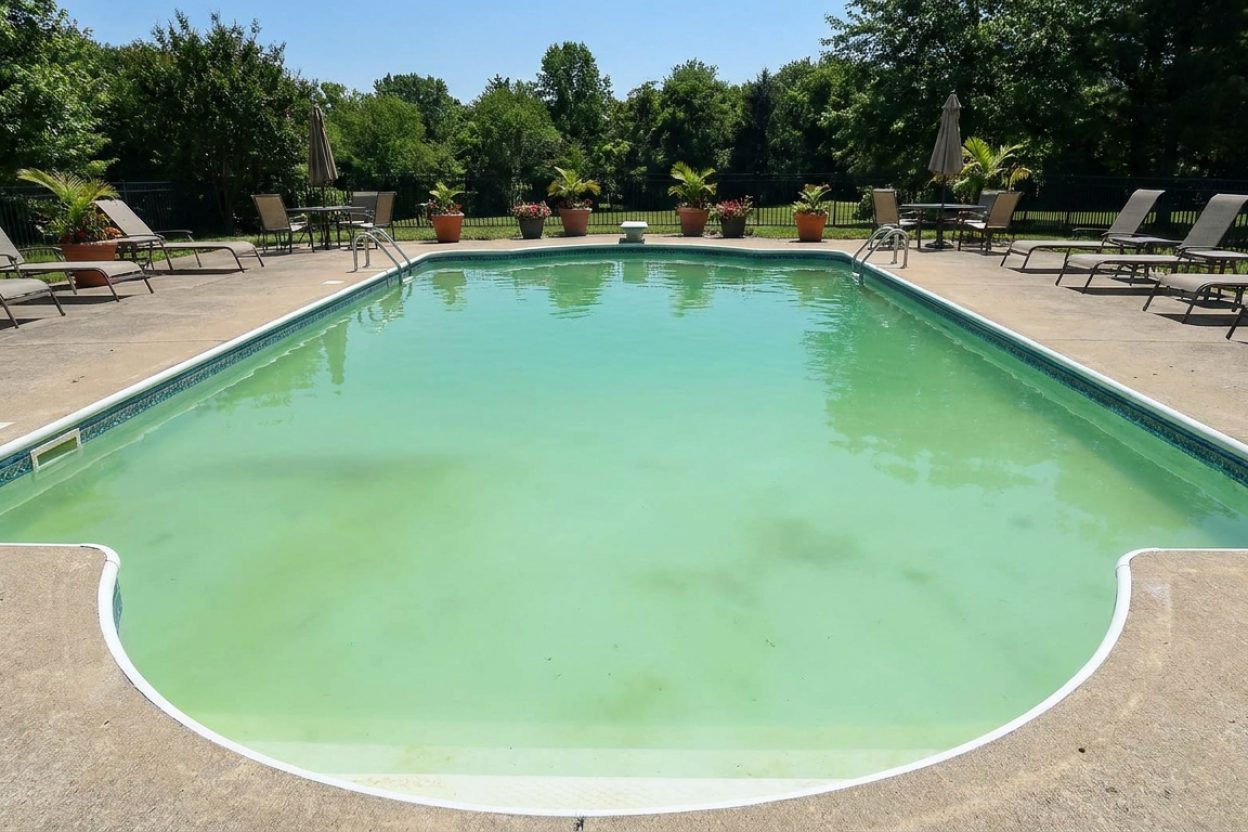
Why is my salt water pool turning green all of a sudden?

Why is my salt water pool turning green all of a sudden?
Read full question
I just checked my salt water pool this morning and the water looks like pea soup. I know salt pools are supposed to be low maintenance, but I don't have any chlorine readings and I'm not sure if my generator is working or if I need to shock it myself.
Quick Answer
Why Your Salt Pool Is Turning Green If your salt water pool is green, it typically means the salt chlorine generator (SCG) isn't producing enough chlorine, or your existing chlorine is being destroyed by high cyanuric acid (CYA). You cannot rely on the generator alone to fix this; you need to manually shock the pool to kill the algae and troubleshoot the system immediately.
Why Your Salt Pool Is Turning Green
If your salt water pool is green, it typically means the salt chlorine generator (SCG) isn't producing enough chlorine, or your existing chlorine is being destroyed by high cyanuric acid (CYACyanuric Acid (stabilizer) — Sunscreen for your chlorine — it keeps sunlight from burning it off. The catch: the more you have, the more chlorine you need to keep. learn more →). You cannot rely on the generator alone to fix this; you need to manually shock the pool to kill the algae and troubleshoot the system immediately.
Most Likely Causes
- Low Chlorine Levels: The generator might be malfunctioning, or the cell is dirty/scaled, leaving you with 0 ppm FCFree Chlorine — The chlorine actively sanitizing your water right now. This is the number you keep an eye on. how much you need →.
- Low Salt Concentration: If salt is below 2700-3400 ppm, the generator struggles to convert salt into chlorine.
- High Cyanuric Acid (CYA): Levels above 80 ppm "lock up" chlorine, making it ineffective against algae.
- High Phosphates: Phosphates are an algae nutrient, but they aren't the root cause — if free chlorine is held at the right level for your CYA, algae won't grow no matter how high the phosphates are. Chasing phosphates is rarely necessary; fix the chlorine first.
- Poor Circulation: Dead spots in the pool filter or pump allow algae to grow in hidden areas.
- High pH: If pH is above 7.8, chlorine effectiveness drops significantly.
Step-by-Step Fix
1. Test Water Chemistry: Check Free Chlorine (FC). For a salt pool it should target roughly 6-8 ppm when CYA is 70-80 — a salt pool needs at least about 5% of its CYA as free chlorine, and a bit more as the working target, not the old 1-3 ppm rule; for algae it needs to be higher still. Test CYA (salt/SWG pools actually want CYA on the higher side, around 70-80 ppm, to shield chlorine from UV) and salt (2700-3400 ppm). Only if CYA climbs well over 100 ppm do you need to partially drain and refill to bring it down.
2. Shock the Pool: Use liquid chlorine (sodium hypochlorite). To kill algae, you need to SLAMShock Level And Maintain — raise free chlorine to a target based on your CYA and hold it there until the algae is gone. It's a process, not a one-time dose. the SLAM walkthrough → the pool—raise FC to the shock level for your CYA (about 40% of CYA). For CYA 70-80, this is about 28-32 ppm. WARNING:Per the CDC pool code (Model Aquatic Health Code), free chlorine should not exceed 10 ppm while anyone is in the water, so wait until it is below 10 ppm to swim. The same code also calls for the water to be clear enough to see the bottom and pH held at 7.0-7.8. You can vacuum at any FC. For a quick estimate, use our all-in-one pool calculator.
3. Clean the Salt Cell: CRITICAL SAFETY: Turn off power at the main breaker, not just the generator switch. Ensure complete electrical isolation before any wet cleaning. Remove the cell from the system completely. If dirty with white crusty scale, clean it with a 4:1 solution of water to muriatic acid (never mix acid types). Rinse thoroughly with water. If you're uncomfortable with electrical work or the cell shows signs of electrical damage, contact a pool professional immediately.
4. Balance pH and Alkalinity: Ensure pH is 7.4-7.6 (acceptable 7.2-7.8). At higher pH a larger share of chlorine shifts to its less-active form, but in a CYA-stabilized pool the practical effect on sanitizing is modest. Keep Total Alkalinity between 80-120 ppm.
5. Run Equipment: Run the pump 24/7 and the filter continuously. Backwash or clean the filter when pressure rises 8-10 psi above clean pressure.
6. Maintain After Clearing: Once the water clears, keep FC at 6-8 ppm until the SCG can maintain it automatically.
When to Call a Professional
Contact a pool service technician if: the salt cell shows electrical damage, the generator control board displays error codes you can't resolve, or you're uncomfortable working with electrical equipment near water.
Safety Note
NEVER mix chemicals. Never mix liquid chlorine with trichlor or cal-hypo, or acid with other pool chemicals. When using muriatic acid, always add acid to water (never water to acid), rinse off any splashes, and avoid breathing the fumes; gloves are a good idea. Always turn off power at the main breaker before servicing electrical equipment.
For the full breakdown of safe chlorine levels by CYA level, see our pool water chemistry guide.
Still need help? Ask a Pool & Spa Expert AD
Get a personalized answer from PoolGuy810 — 30 years owning a pool and spa repair company. Describe your issue and get step-by-step help.
Related Pool Guides
Need More Help?
Try our free pool calculators and tools to help diagnose and fix your pool problems.
Browse Pool ToolsSLAM calculator, pH calculator, salt dosing & more