
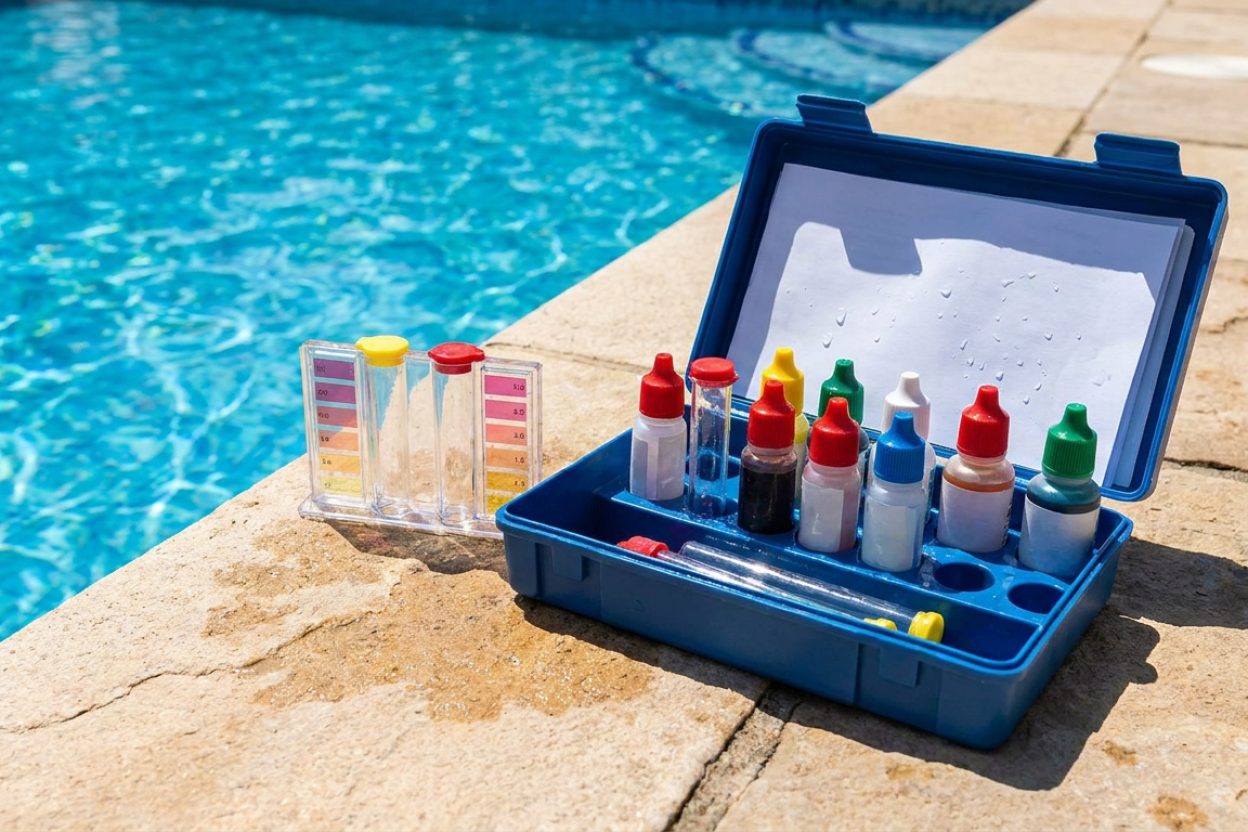
What Free Chlorine Level Should You Maintain?

What free chlorine level should I actually be targeting?
Read full question
Found myself staring at my test kit at 11pm trying to figure out if my chlorine reading is even close to where it should be. It's late and I want to get a dose in tonight if I'm off, but I genuinely don't know what number I'm shooting for. My pool has stabilizer in it and I've been guessing at a target for months.
Is there a universal number everyone aims for, or does it actually vary based on something? I keep seeing different ranges thrown around online and I can't figure out which one applies to my situation.
Quick Answer
The correct free chlorine level isn't a single universal number — it scales directly with your CYA (stabilizer) level. A pool with higher CYA needs more free chlorine to stay sanitized. Understanding that relationship is the key to keeping your water safe and clear. The article explains how to determine the right FC target based on your CYA level, using standardized target ranges and the FC/CYA ratio.
Why There's No Single "Right" Number
This is one of the most common points of confusion for pool owners, and honestly, it's not your fault — a lot of outdated advice still floats around saying things like "keep it between 1 and 3 ppm" as if that's a universal rule. It isn't, and chasing that target in a stabilized pool can actually leave your water chronically under-sanitized.
The real answer is that your free chlorine (FCFree Chlorine — The chlorine actively sanitizing your water right now. This is the number you keep an eye on. how much you need →) target scales with your CYACyanuric Acid (stabilizer) — Sunscreen for your chlorine — it keeps sunlight from burning it off. The catch: the more you have, the more chlorine you need to keep. learn more → level. CYA — also called cyanuric acid or stabilizer — protects chlorine from being destroyed by UV sunlight, which is great. But it also reduces chlorine's effectiveness at any given concentration. The more CYA you have in the water, the more free chlorine you need to maintain the same sanitizing power. This is sometimes called the FC/CYAFC/CYA chart — The chart that sets your chlorine target from your stabilizer (CYA) level — the two go together. see the chart → ratio, and it's the foundation of solid pool chemistry. You can read much more about how all of this fits together in the pool water chemistry guide.
What the Numbers Actually Look Like
Here's the practical version: if your CYA is on the lower end — say around 30-40 ppm, which is typical for a lightly stabilized pool — you'd want a minimum of roughly 3 ppm free chlorine at 40 ppm CYA (a little less at 30), with around 5 ppm as a comfortable target. But if your CYA is higher, like 60-80 ppm (common in outdoor pools that see a lot of sun and get regular stabilizer additions), both numbers climb accordingly — a minimum around 5-6 ppm and a target of roughly 7-10 ppm to stay reliably effective.
A widely cited guideline in the pool chemistry community suggests keeping your FC at roughly 7.5% of your CYA level as a minimum — though recommendations can vary by source, and commercial or regulated pools may have different requirements. Treat 7.5% as a floor, not the target: popular references like Trouble Free Pool actually aim higher (their target FC works out closer to 11-13% of CYA for a manually-dosed pool, and a bit lower for salt pools), so the "comfortable buffer" numbers here are closer to the real day-to-day target than the bare minimum. So if your CYA reads 60 ppm, your minimum is around 4-5 ppm of free chlorine, while a target closer to 7-8 ppm gives you a comfortable margin before it dips too low. The all-in-one pool calculator can help you estimate how much product to add to hit your target based on your pool's volume.
What If Your CYA Is High?
This is where things get a bit tricky. Many pools — especially ones that have been using stabilized chlorine products like trichlor tablets or dichlor for a while — accumulate CYA over time. If your CYA is up around 80-100 ppm or more, the required free chlorine level to maintain proper sanitation becomes harder and harder to sustain. At very high CYA levels, the pool becomes increasingly resistant to the effects of chlorine no matter how much you add. The typical solution at that point is to partially drain and refill the pool with fresh water to bring CYA back down to a manageable range, usually somewhere in the 30-50 ppm range for non-salt pools, though targets can vary by source and jurisdiction — verify with your local guidelines or a pool professional if you're unsure.
Testing Matters More Than You Think
To hit the right target, you need to actually know your CYA level — and that means using a proper test kit, not just pool store strips. A quality FAS-DPDFAS-DPD test — A drop-based test that reads chlorine accurately even at high "shock" levels, where test strips give up. see test kits → test kit — such as those from Taylor or LaMotte — gives you reliable readings for free chlorine. Make sure your kit also includes a CYA (cyanuric acid) test, or purchase a separate CYA test kit, as not all kits include this by default. If you're only testing FC without knowing your CYA, you're essentially flying blind on whether your chlorine is actually working.
You'll want to test free chlorine regularly — ideally a few times a week during swim season, especially in hot weather and high-use periods, when chlorine is consumed more quickly through increased bather load, higher biological activity, and UV exposure. If you have a salt chlorine generator, the same FC/CYA relationship still applies; you'd just be adjusting your generator output rather than adding liquid chlorine manually. For more on that specific setup, the salt water pool guide walks through how to balance everything together.
A Quick Practical Checklist
- Test your CYA first — you can't set a chlorine target without it
- Use the 7.5% rule as a starting point — minimum FC should be roughly 7.5% of your CYA level, per widely used community guidelines
- Aim a bit higher than the minimum — a comfortable buffer prevents dipping into unsafe territory between doses
- Test FC at least 2-3 times per week in swimming season, more often in very hot or heavily-used pools
- Watch for CYA creep if you're using stabilized chlorine products regularly
The Short Version for Tonight
If you're trying to figure out whether to dose right now: test your CYA if you haven't recently, then use that number to set your FC target. Remember, the minimum FC threshold scales with CYA — at 40 ppm CYA the minimum is around 3 ppm FC, and at 60 ppm CYA it's around 4-5 ppm, with a ppm or two above the minimum as a comfortable buffer. If your FC has dropped below that threshold for your CYA level, adding chlorine to bring it back up to a comfortable buffer above the minimum is a reasonable move. The pool calculator will estimate how much to add for your pool size. Getting into the habit of keeping FC in the right zone relative to your CYA is honestly one of the biggest things you can do to keep your water consistently clear and safe.
 Taylor K-2006C Complete FAS-DPD Pool & Spa Test Kit
The FAS-DPD kit pool pros trust — reads chlorine accurately even at shock/SLAM levels, plus pH, alkalinity, calcium hardness and CYA. View on Amazon →
Taylor K-2006C Complete FAS-DPD Pool & Spa Test Kit
The FAS-DPD kit pool pros trust — reads chlorine accurately even at shock/SLAM levels, plus pH, alkalinity, calcium hardness and CYA. View on Amazon →
 Liquid Chlorine / Sodium Hypochlorite (12.5%)
Everyday sanitizer — the B in BBB View on Amazon →
Liquid Chlorine / Sodium Hypochlorite (12.5%)
Everyday sanitizer — the B in BBB View on Amazon →
Still need help? Ask a Pool & Spa Expert AD
Get a personalized answer from PoolGuy810 — 30 years owning a pool and spa repair company. Describe your issue and get step-by-step help.
Related Pool Guides
Need More Help?
Try our free pool calculators and tools to help diagnose and fix your pool problems.
Browse Pool ToolsSLAM calculator, pH calculator, salt dosing & more