
How Long Do Pool Chemicals Last? Complete Shelf Life Guide

What are the exact shelf life limits for different pool chemicals?
Read full question
Somewhere in my garage I've got old pool chemicals from last season, but I can't afford to replace them all — is there a way to test if they're still good for under $20?
Specifically looking for technical specifications on how long liquid chlorine maintains potency versus granular forms, and whether chemicals like sodium bicarbonate and muriatic acid have definitive expiration parameters. Storage conditions are controlled temperature and humidity, so assuming optimal preservation environment.
Quick Answer
Pool chemical shelf life varies a lot: liquid chlorine fades fast (it loses roughly half its strength in about 6 months, so buy it fresh and do not stockpile), while trichlor tablets keep about 2-3 years and dichlor granules about 1-2 years and pH and alkalinity adjusters last almost indefinitely when stored cool, dry, and out of the sun.
Chlorine-Based Chemicals
Liquid Chlorine (Sodium Hypochlorite)
Liquid chlorine has a relatively short shelf life among chlorine products when stored correctly. Fresh liquid chlorine typically contains 10-12.5% available chlorine and degrades at varying rates depending on storage temperature and conditions. Store in a cool, dark location below 80°F to maximize longevity. UV light and direct sunlight accelerate degradation significantly - never store liquid chlorine where it receives any sun exposure.
Shelf Life: Short — figure a couple of months for full strength. Fresh liquid chlorine loses roughly half its available chlorine over about 3 months at room temperature (around 20% a month), and much faster in heat or direct sun. Buy it fresh, check the date on the jug, and use it up rather than stockpiling it.
Signs of degradation: Yellowish color, reduced chlorine smell, or available chlorine testing below 10% indicates significant degradation.
Calcium Hypochlorite (Cal-Hypo)
Granular calcium hypochlorite is highly stable when kept dry and cool. This pool shock typically contains 65-73% available chlorine and maintains potency well when moisture is prevented.
Shelf Life: 2-3 years in original sealed container, 1 year after opening if resealed properly.
Critical storage requirement: Must remain completely dry. Even small amounts of moisture can cause dangerous chemical reactions and rapid degradation.
Trichlor and Dichlor
Stabilized chlorine products like trichlor tablets and dichlor granules contain cyanuric acid and maintain their chlorine content well when stored properly.
Shelf Life: 2-3 years for trichlor tablets, 1-2 years for dichlor granules.
Storage note: Trichlor tablets can become brittle and crumble over time, but this doesn't necessarily indicate loss of effectiveness.
pH and Alkalinity Adjusters
Muriatic Acid (Hydrochloric Acid)
Muriatic acid is extremely stable and doesn't lose potency over time when stored in its original container.
Shelf Life: Indefinite when stored properly.
Storage requirements: Keep tightly sealed in original container, store in cool, ventilated area away from metals and other chemicals.
Dry Acid (Sodium Bisulfate)
Sodium bisulfate granules remain effective indefinitely when kept dry.
Shelf Life: Indefinite with proper storage.
Signs of problems: Clumping indicates moisture exposure but doesn't necessarily mean the product is ineffective.
Soda Ash (Sodium Carbonate)
Sodium carbonate for raising pH is extremely stable and long-lasting.
Shelf Life: Indefinite when stored in dry conditions.
Specialty Chemicals
Cyanuric Acid (Stabilizer)
Pool stabilizer is highly stable and maintains effectiveness for years. This is crucial for maintaining proper FC/CYAFC/CYA chart — The chart that sets your chlorine target from your stabilizer (CYA) level — the two go together. see the chart → ratios in your pool chemistry program.
Shelf Life: Indefinite when kept dry.
Target levels: Maintain 30-50 ppm for regular chlorinated pools, 70-80 ppm for salt water generators.
Calcium Chloride
Used for increasing calcium hardness, calcium chloride flakes or pellets last indefinitely when stored properly.
Shelf Life: Indefinite in dry storage.
Target range: 250-350 ppm for plaster pools; vinyl and fiberglass don't need calcium for the surface, so 175-225 ppm there is only for water balance and equipment (err toward the low end).
Algaecides and Clarifiers
Liquid algaecides and clarifiers typically have shorter shelf lives due to their complex formulations.
Shelf Life: 2-3 years for most liquid products, check manufacturer dates.
Storage: Protect from freezing, which can permanently damage effectiveness.
Optimal Storage Conditions
Temperature Control
Store all pool chemicals in locations where temperature remains below 80°F. High temperatures accelerate chemical degradation and can create dangerous conditions, especially with chlorine products.
Moisture Prevention
Dry chemicals must remain moisture-free. Use tight-fitting lids, consider adding desiccant packets to opened containers, and never use wet scoops.
Separation Requirements
Never store different chemical types together. Particularly dangerous combinations include chlorine products with acids, or different types of chlorine products together.
Testing Chemical Effectiveness
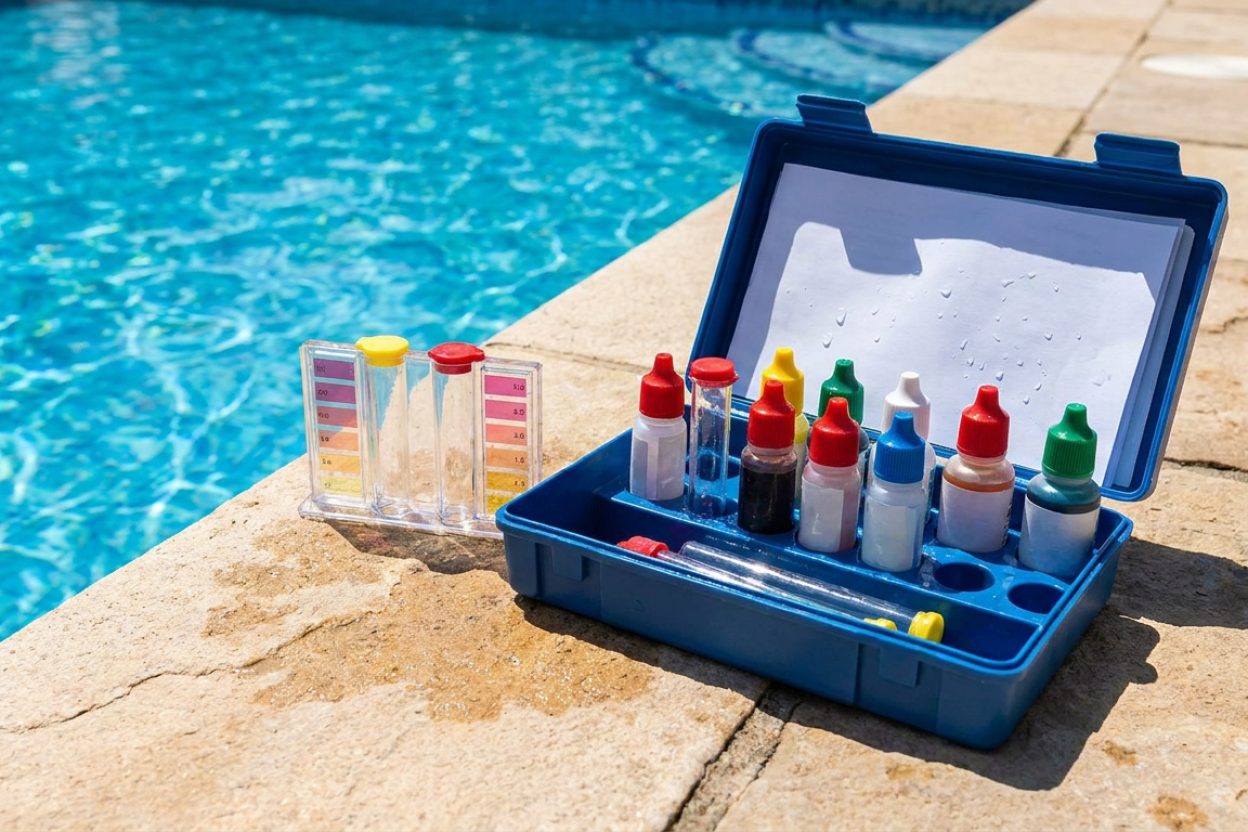
Use a reliable test kit like the Taylor K-2006 to verify chemical effectiveness. When adding aged chemicals, test and retest after 30 minutes to confirm expected results.
For chlorine products, if you need significantly more than the standard dosing, your chemicals may have degraded.
Common Storage Mistakes to Avoid
- Storing in garage during summer: High temperatures rapidly degrade chemicals
- Leaving containers open: Moisture and contamination reduce effectiveness
- Using damaged containers: Cracks or damaged lids compromise chemical integrity
- Ignoring manufacturer dates: While many chemicals last beyond printed dates, very old products may be significantly less effective
- Cross-contamination: Using the same scoop for different chemicals can cause dangerous reactions
Following these guidelines ensures your pool chemicals maintain maximum effectiveness and safety throughout their shelf life, supporting proper water chemistry maintenance using proven methods like SLAMShock Level And Maintain — raise free chlorine to a target based on your CYA and hold it there until the algae is gone. It's a process, not a one-time dose. the SLAM walkthrough → (Shock Level And Maintain) when needed.
For the full breakdown of safe chlorine levels by CYACyanuric Acid (stabilizer) — Sunscreen for your chlorine — it keeps sunlight from burning it off. The catch: the more you have, the more chlorine you need to keep. learn more → level, see our pool water chemistry guide.

Still need help? Ask a Pool & Spa Expert AD
Get a personalized answer from PoolGuy810 — 30 years owning a pool and spa repair company. Describe your issue and get step-by-step help.
Related Pool Guides
Need More Help?
Try our free pool calculators and tools to help diagnose and fix your pool problems.
Browse Pool ToolsSLAM calculator, pH calculator, salt dosing & more