
Can I Shock Pool After Adding Alkalinity? Timing Guide

How long should I wait to shock after raising alkalinity?
Read full question
Walked out to check my 20,000 gallon inground pool after dosing it with sodium bicarbonate this morning to raise alkalinity from 60 ppm to 100 ppm, and now I'm second-guessing my shocking timeline. My pH was sitting at about 7.2 before I added the alkalinity increaser, but I know adding baking soda can bump up the pH as well.
I'm planning to shock the pool tonight since we've had some heavy swimmer load this week and the water is starting to look a bit cloudy. Should I wait a certain amount of time after adding the alkalinity before I shock? I want to make sure the shock is as effective as possible and I've heard that pH levels can affect how well chlorine works.
My current test results show chlorine at 1.5 ppm, alkalinity should now be around 100 ppm, and I'm not sure what the pH has risen to after adding the sodium bicarbonate earlier today.
Quick Answer
Yes — and you do not need to wait long. Sodium bicarbonate (alkalinity increaser) mixes within an hour or so and does not react with chlorine, so the only reason to pause is to let pH settle enough to test it. Check pH a couple of hours after adding bicarb and you can usually shock that same evening.
First, Let's Diagnose the Timing Issue
First thing to check: your alkalinity levels and the clock on your wall. When you add alkalinity increaser (sodium bicarbonate), it mainly raises total alkalinity and nudges pH up only slightly—bicarb sits around pH 8.3, so it is a weak pH mover (soda ash is the chemical that swings pH hard). Chlorine does work a little better at lower pH, so it is worth a quick pH check before you shock, but after a bicarb dose your pH usually has not jumped enough to scramble over. So wait a couple hours, test and shock.
Understanding the Chemical Relationship
Total alkalinity acts as a pH buffer, preventing rapid pH swings in your pool water. When you add alkalinity increaser, you are adding sodium bicarbonate, which raises TATotal Alkalinity — The buffer that keeps your pH from bouncing around. Get this in range and pH gets a lot easier to manage. learn more → strongly and pH only slightly. pH still matters for chlorine’s killing power, though—at pH 8.0 only about 23% of your free chlorine is in the active form (hypochlorous acid), versus roughly 65% at pH 7.2. But those classic figures are for water without stabilizer - once CYACyanuric Acid (stabilizer) — Sunscreen for your chlorine — it keeps sunlight from burning it off. The catch: the more you have, the more chlorine you need to keep. learn more → is present it dominates how chlorine behaves and pH has much less effect on sanitizing power, so a quick pH check is worthwhile but there's no need to chase a perfect number.
This is why proper sequencing and timing matter when treating your pool water.
Step-by-Step Solution Process
Immediate Steps After Adding Alkalinity
- Let it mix and settle: Bicarb dissolves and disperses quickly—with the pump running you are fully mixed in well under an hour (give it a turnover or two to be safe). The reason to wait a bit longer is not safety; it is so pH has settled and you can get an accurate reading before deciding whether to adjust it. A couple of hours is plenty.
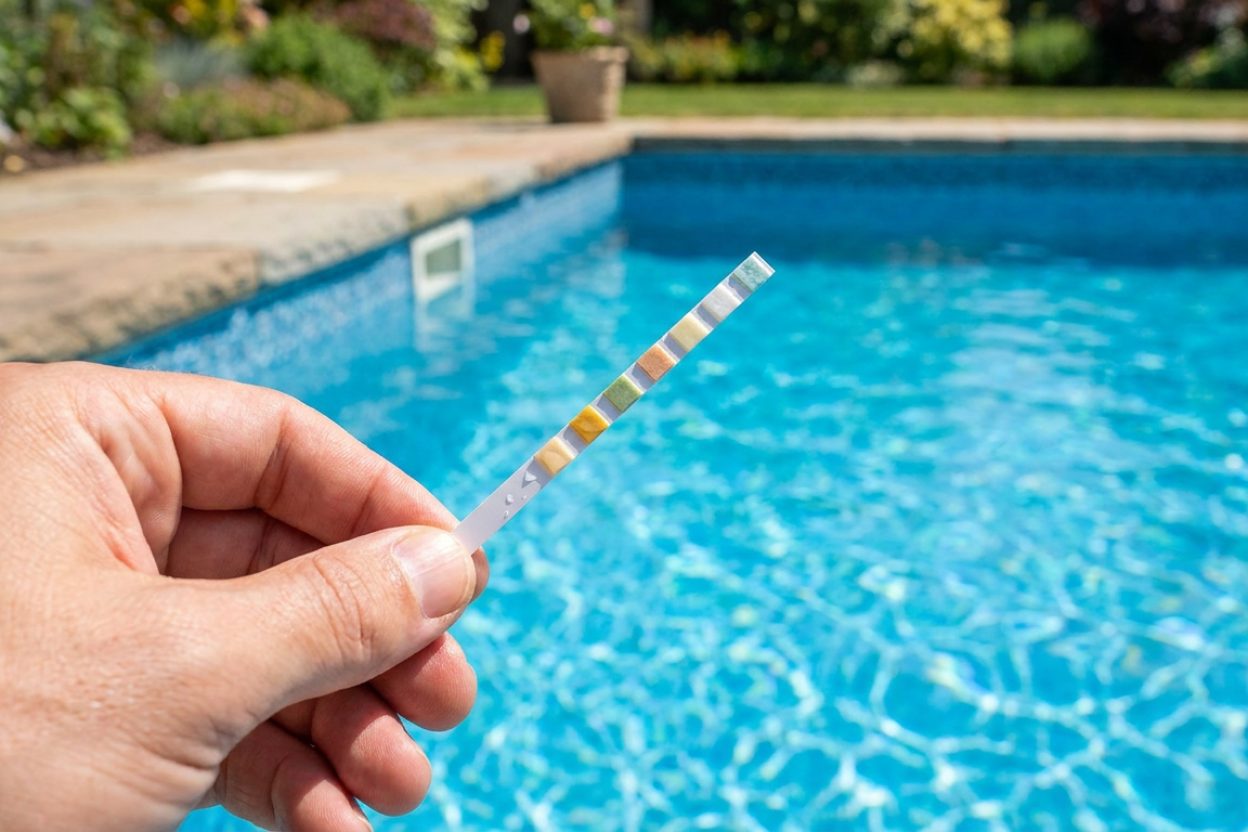
- Test your water: Use a reliable test kit like the Taylor K-2006 to measure both pH and total alkalinity levels. Don't rely on test strips for accuracy during chemical adjustments.
- Check pH levels: If pH is above 7.8, nudge it down before shocking - but in a stabilized pool (with CYA), the CYA buffers chlorine's activity, so pH anywhere in the normal 7.2-7.8 range matters far less than hitting the right FCFree Chlorine — The chlorine actively sanitizing your water right now. This is the number you keep an eye on. how much you need → for your CYA. Don't delay a needed shock chasing a perfect pH. Add muriatic acid in small increments (see manufacturer specifications for dosage as pH reduction varies based on current pH, total alkalinity, and acid concentration).
- Retest after pH adjustment: Wait another 2-4 hours with circulation running, then retest pH to confirm it's in the ideal 7.2-7.4 range.
Proper Shocking Procedure
- Calculate shock dosage: Use liquid chlorine (sodium hypochlorite) rather than calcium hypochlorite shock, especially if you've recently adjusted alkalinity. For standard shocking, add enough liquid chlorine to reach the shock level for your CYA (use the all-in-one pool calculator to determine the right amount).
- Add shock in evening: Shocking in the evening is best (daytime sun burns off chlorine faster), but you can shock during the day when you need to — like a fresh opening or a green pool — just expect to use a bit more. Pour liquid chlorine around the pool perimeter with pump running.
- Maintain circulation: Keep your pump running continuously during the shocking process. This typically means 8-24 hours depending on your pool's condition.
- Monitor progress: Test chlorine levels every few hours. For routine shocking, chlorine should drop to normal levels (6-8 ppm for CYA 60-80) within 8-12 hours.
Troubleshooting Common Issues
pH Won't Stabilize
If pH keeps climbing after adding alkalinity increaser, your total alkalinity may be too high. Target ranges are 80-120 ppm for traditional chlorine pools, or 60-80 ppm for salt water generators. High alkalinity requires careful pH management with muriatic acid.
Shock Isn't Working Effectively
This usually indicates pH is still too high, or you have high cyanuric acid (CYA) levels. Test CYA and use the all-in-one pool calculator to determine proper shock levels (shock requirements vary based on CYA levels and treatment purpose).
Cloudy Water After Treatment
Cloudiness after adding alkalinity increaser and shocking usually means insufficient mixing time or pH imbalance. Continue running your pump and consider adding a clarifier if cloudiness persists after 24 hours.
Safety Considerations and Best Practices
Don’t combine chemicals in a bucket or the same spot: Add them separately into the water with the pump running so each disperses on its own. To be clear, bicarb and chlorine do not react dangerously—you can add both the same day. The real hazard is combining concentrated chemicals directly (for example pouring different chlorine types together, or mixing acid and chlorine in a bucket), which is why everything goes into the pool separately rather than container-to-container.
Proper storage: Store alkalinity increaser in a cool, dry place away from other pool chemicals. Keep liquid chlorine in a cool area away from direct sunlight and other chemicals.
Personal protection: Wear safety glasses and gloves when handling all pool chemicals. Work upwind when adding chemicals to avoid inhaling fumes.
Long-term Water Balance Strategy
Rather than reactive treatments, develop a proactive approach to water balance. Test your pool water 2-3 times per week, focusing on maintaining proper alkalinity levels (which change slowly) and adjusting pH as needed (which can fluctuate daily).
Consider the relationship between all chemical parameters: total alkalinity, pH, free chlorine, cyanuric acid, and calcium hardness all work together. Making dramatic changes to one parameter often requires adjustments to others.
For pools requiring frequent alkalinity adjustments, investigate underlying causes like heavy bather loads, acidic source water, or equipment issues that might be causing pH instability.
For the full breakdown of safe chlorine levels by CYA level, see our pool water chemistry guide.
 Taylor K-2006C Complete FAS-DPD Pool & Spa Test Kit
The FAS-DPD kit pool pros trust — reads chlorine accurately even at shock/SLAM levels, plus pH, alkalinity, calcium hardness and CYA. View on Amazon →
Taylor K-2006C Complete FAS-DPD Pool & Spa Test Kit
The FAS-DPD kit pool pros trust — reads chlorine accurately even at shock/SLAM levels, plus pH, alkalinity, calcium hardness and CYA. View on Amazon →
 Liquid Chlorine / Sodium Hypochlorite (12.5%)
Everyday sanitizer — the B in BBB View on Amazon →
Liquid Chlorine / Sodium Hypochlorite (12.5%)
Everyday sanitizer — the B in BBB View on Amazon →
 Acid Blue - Low Fume Muriatic Acid for Swimming Pools & Spas - Lower's pH, Reduces Alkalinity - 2 Gallon
View on Amazon →
Acid Blue - Low Fume Muriatic Acid for Swimming Pools & Spas - Lower's pH, Reduces Alkalinity - 2 Gallon
View on Amazon →
 Arm & Hammer Pure Baking Soda (Alkalinity Up)
Raises Total Alkalinity cheaply View on Amazon →
Arm & Hammer Pure Baking Soda (Alkalinity Up)
Raises Total Alkalinity cheaply View on Amazon →
Still need help? Ask a Pool & Spa Expert AD
Get a personalized answer from PoolGuy810 — 30 years owning a pool and spa repair company. Describe your issue and get step-by-step help.
Related Pool Guides
Need More Help?
Try our free pool calculators and tools to help diagnose and fix your pool problems.
Browse Pool ToolsSLAM calculator, pH calculator, salt dosing & more