
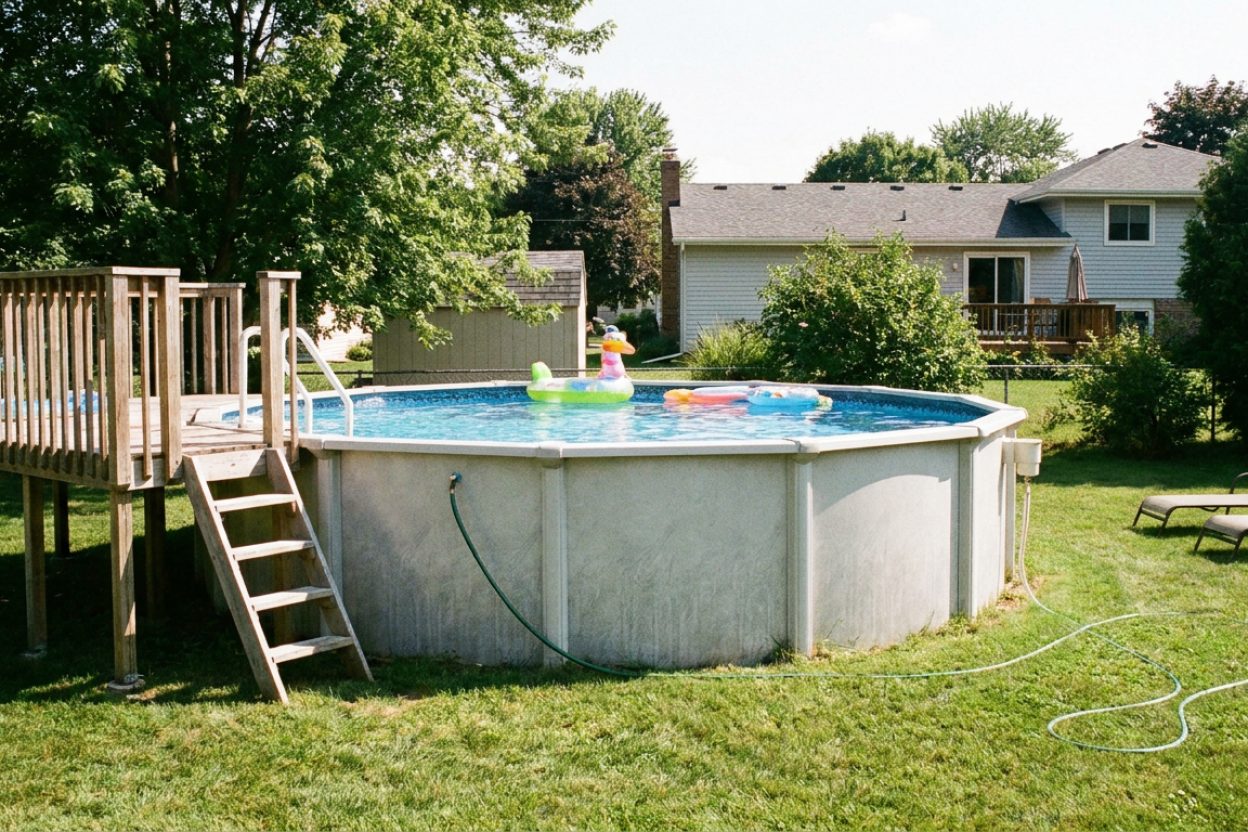
Can You Clean Above Ground Pool with Bleach? Complete Guide

Household bleach vs pool chlorine for above ground pool cleaning?
Read full question
Halfway through pool season my 24-foot round above ground pool has disgusting algae buildup, murky water, AND I'm hemorrhaging money on expensive chemicals. I noticed that regular household bleach contains sodium hypochlorite just like pool chlorine, and it's often cheaper at the grocery store.
I've been using liquid pool chlorine from the pool store, but with how much I go through during peak season, the costs really add up. My pool stays pretty balanced - typically around 7.2-7.4 pH and 1.5-3.0 ppm chlorine when I test weekly. Can I substitute regular unscented household bleach for pool chlorine to clean and sanitize my above ground pool? If so, are there any differences in dosing or effectiveness I should know about?
Quick Answer
Yes, you can clean above ground pools with unscented liquid household bleach (5.25-6% sodium hypochlorite), but liquid pool chlorine is easier to dose and store; on cost, bulk-refilled pool chlorine is usually cheapest, while at retail bleach and jugged chlorine run close. This guide covers the types of bleach safe for pool use, calculating bleach dosage, step-by-step cleaning, the SLAM method, cost comparison, safety considerations, and alternative sanitization methods.
Using Household Bleach in Above Ground Pools
First question: are you staring at green, cloudy water wondering if that jug of Clorox under your sink can save your swimming season? Unscented liquid bleach is essentially diluted sodium hypochlorite - the same active ingredient found in liquid pool chlorine.
Types of Bleach Safe for Pool Use
Only use unscented liquid bleach containing 5.25-6% sodium hypochlorite with no additives. Common brands like Clorox Regular Bleach work perfectly. Never use:
- Scented or colored bleach
- Ultra-concentrated bleach (over 8%)
- Splash-less or thickened formulas
- Bleach with fabric softeners or brighteners
These additives can create foam, stain your liner, or introduce unwanted chemicals that won't break down properly in pool water.
Calculating Bleach Dosage for Your Pool
Household bleach is weaker than liquid pool chlorine, so you'll need more volume. For a typical 6% bleach:
For a handy reference to calculate your bleach dosage, use our all-in-one pool calculator.
- To raise FCFree Chlorine — The chlorine actively sanitizing your water right now. This is the number you keep an eye on. how much you need → by 1 ppm: add about 21 fl oz of 6% household bleach (or ~11 fl oz of 12.5% liquid chlorine) per 10,000 gallons of pool water
- For shock treatment: Calculate your shock level based on CYACyanuric Acid (stabilizer) — Sunscreen for your chlorine — it keeps sunlight from burning it off. The catch: the more you have, the more chlorine you need to keep. learn more → using the FC/CYAFC/CYA chart — The chart that sets your chlorine target from your stabilizer (CYA) level — the two go together. see the chart → chart, then multiply accordingly
- Daily maintenance: Start with 1-2 ppm FC loss per day and adjust based on testing, ensuring FC levels are within the target range for your CYA (use the all-in-one pool calculator for guidance)
As a rule of thumb, a gallon of 6% household bleach raises FC by roughly 6 ppm per 10,000 gallons (12.5% liquid chlorine is about twice as strong). For the amount that fits your pool, use our easy-to-use pool calculator or browse our pool guides — then add with the pump running and retest.
Step-by-Step Pool Cleaning with Bleach
Testing and Preparation
- Test your water with a reliable kit like Taylor K-2006C for accurate FC, pH, and CYA readings
- Ensure pH is in the normal range (7.2-7.8) before adding chlorine; this is for comfort and balance, since lower pH actually makes chlorine slightly more active
- Calculate your target FC level based on your CYA reading using the FC/CYA relationship — our all-in-one pool calculator estimates the free chlorine target for your CYA.
- Have your pool pump running for proper circulation
Adding Bleach Safely
- Pour bleach slowly around the pool perimeter while walking, never dump in one spot
- Add bleach near return jets for better mixing and circulation
- Allow 30 minutes of circulation before retesting FC levels
- Add additional bleach if needed to reach target levels
- Retest after 2 hours to confirm FC is holding steady
When to Use the SLAM Method
If your above ground pool is green or cloudy, you'll need to perform a SLAMShock Level And Maintain — raise free chlorine to a target based on your CYA and hold it there until the algae is gone. It's a process, not a one-time dose. the SLAM walkthrough → (Shock Level And Maintain) process:
- Determine your shock level FC based on CYA (typically 40% of your CYA level)
- Add enough bleach to reach shock level immediately
- Maintain that FC level 24/7 by testing every few hours and adding bleach as needed
- Continue until you can maintain shock level overnight without FC loss
- Brush pool walls and floor twice daily during SLAM
For a green pool with 50 ppm CYA, you'd maintain 20 ppm FC (40% of CYA) continuously until clear.
Cost Comparison: Bleach vs. Pool Chlorine
Both are the same chemical (sodium hypochlorite), so which is cheaper comes down to local pricing. Compare the cost per unit of available chlorine — divide price per gallon by the % strength; lower wins:
- Household bleach: 6% ("regular") up to 7.5–8.25% ("concentrated"/"disinfecting"), commonly about $4–8 per gallon.
- Liquid pool chlorine: 10–12.5%, roughly $5–9 per gallon at retail — far cheaper (around $2) if you refill jugs at a pool store.
- Compare by strength, not sticker price: pool liquid chlorine is more concentrated than household bleach, so it usually delivers more chlorine per dollar — but the two are often close, and when pool chlorine is priced high locally, bleach can actually be the better value. Check the price against the percentage on the label.
- Convenience: pool chlorine is more concentrated, so you haul and store roughly half the volume for the same dose.
For regular maintenance, bulk pool chlorine refilled at a pool store is usually the cheapest option and the easiest to handle; at typical retail prices, bleach and jugged pool chlorine are close enough that it is worth checking your local prices per unit before deciding.
Safety Considerations
Never mix bleach with other chemicals - add them separately with circulation in between. Store bleach in a cool, dark place as it loses potency over time. Liquid bleach keeps for several months (its lower concentration degrades a bit slower), while pool-strength liquid chlorine loses roughly 20% per month at room temperature—so both are best bought fresh.
Monitoring and Maintenance
Test FC levels daily, especially during hot weather or heavy use. Your above ground pool will typically lose 1-3 ppm FC per day through UV breakdown and oxidation of contaminants. Maintain FC levels according to your CYA reading - typically 4-6 ppm for outdoor pools with 30-50 ppm CYA, and roughly 8-11 ppm for pools with 70-80 ppm CYA.
Alternative Sanitization Methods
While bleach and liquid chlorine are most common, consider these alternatives for above ground pools:
- Chlorine tablets: Convenient but add CYA over time
- Saltwater systems: Generate chlorine automatically but require higher CYA levels (70-80 ppm)
- UV systems: Reduce chlorine demand when combined with low FC levels
Each method has trade-offs in cost, convenience, and water balance requirements for your specific above ground pool setup.
For the full breakdown of safe chlorine levels by CYA level, see our pool water chemistry guide.
 Taylor K-2006C Complete FAS-DPD Pool & Spa Test Kit
The FAS-DPD kit pool pros trust — reads chlorine accurately even at shock/SLAM levels, plus pH, alkalinity, calcium hardness and CYA. View on Amazon →
Taylor K-2006C Complete FAS-DPD Pool & Spa Test Kit
The FAS-DPD kit pool pros trust — reads chlorine accurately even at shock/SLAM levels, plus pH, alkalinity, calcium hardness and CYA. View on Amazon →
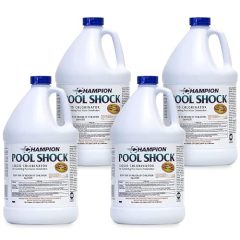 Liquid Chlorine / Sodium Hypochlorite (12.5%)
Everyday sanitizer — the B in BBB View on Amazon →
Liquid Chlorine / Sodium Hypochlorite (12.5%)
Everyday sanitizer — the B in BBB View on Amazon →
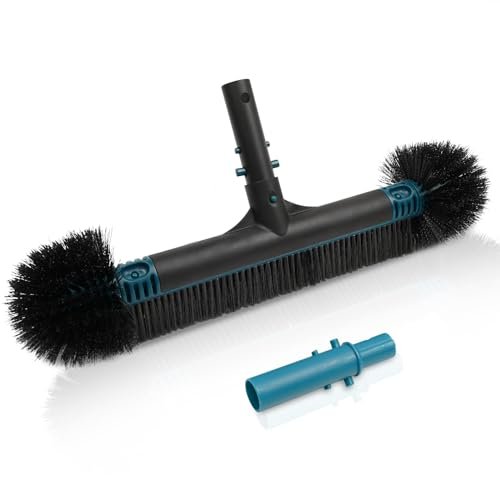 Poolvio 20" 2-in-1 Pool Brush Head (Walls & Floor)
Sturdy 20-inch brush head that clips onto any standard telescopic pole. View on Amazon →
Poolvio 20" 2-in-1 Pool Brush Head (Walls & Floor)
Sturdy 20-inch brush head that clips onto any standard telescopic pole. View on Amazon →
Still need help? Ask a Pool & Spa Expert AD
Get a personalized answer from PoolGuy810 — 30 years owning a pool and spa repair company. Describe your issue and get step-by-step help.
Related Pool Guides
Need More Help?
Try our free pool calculators and tools to help diagnose and fix your pool problems.
Browse Pool ToolsSLAM calculator, pH calculator, salt dosing & more