
Should I Turn Off Salt Cell When Shocking Pool? Complete Guide

Salt Cell Operation During Pool Shock Treatment - Turn Off?
Read full question
Staring at my salt cell wondering if I need to turn it off before shocking my pool — can't afford a $200 service call right now.
Should the salt chlorine generator be turned off while administering shock treatment, or can it continue running?
I want to ensure I'm following correct procedures to avoid any potential equipment damage or interference with the shock's effectiveness. What's the standard protocol for salt cell operation during chemical shock applications?
Quick Answer
Yes - turn your salt cell off before adding shock and leave it off until free chlorine returns to your normal range for your CYA. It is not that shock damages the cell; there is simply no benefit to it producing while you dose by hand, and it makes levels harder to control. Separately, on a salt pool mind your shock type: cal-hypo adds calcium and dichlor adds CYA, so liquid chlorine is usually the best choice.
Why Turn Off Your Salt Cell When Shocking
Salt water generators are designed to produce chlorine at steady, moderate levels. When you shock your pool, you're dramatically increasing chlorine levels - often to 10-30 ppm or higher. Running your salt cell during shock won't harm it, but it's still worth switching off. Here's the real picture:
- No benefit: the cell doesn't need to keep producing chlorine while you're dosing manually, so leave it off
- Inefficient shocking: Your salt cell will continue producing chlorine even when levels are already high, making it harder to control exact chlorine levels
- Not a scaling risk: shocking itself doesn't scale the cell - scaling comes from high calcium hardness and pH, so it's a non-issue here
- pH drift: pH tends to rise in salt pools (from CO2 outgassing as the cell agitates the water, not from the cell itself), so check and adjust pH into the low-to-mid 7s before shocking, since chlorine works best at lower pH
Complete Shocking Process for Salt Water Pools
Before Shocking
- Test your water chemistry using a reliable test kit like the Taylor K-2006C
- Record current free chlorine (FCFree Chlorine — The chlorine actively sanitizing your water right now. This is the number you keep an eye on. how much you need →), pH, total alkalinity (TATotal Alkalinity — The buffer that keeps your pH from bouncing around. Get this in range and pH gets a lot easier to manage. learn more →), and cyanuric acid (CYACyanuric Acid (stabilizer) — Sunscreen for your chlorine — it keeps sunlight from burning it off. The catch: the more you have, the more chlorine you need to keep. learn more →) levels
- Turn off your salt water generator at the control panel
- Ensure your pool pump will continue running for circulation
- Calculate proper shock dosage (use the FC/CYAFC/CYA chart — The chart that sets your chlorine target from your stabilizer (CYA) level — the two go together. see the chart → chart - your shock/SLAM target is roughly 40% of your CYA; there's no fixed 'shock to 10-15 ppm' number on a stabilized pool)
During Shocking
- Add liquid chlorine (sodium hypochlorite) in the evening to avoid UV degradation
- Pour shock chemicals around the pool perimeter while pump is running
- For a quick estimate — our all-in-one pool calculator works out how much shock to add based on your pool size and current vs. target FC levels, and is more reliable than hand calculations since amounts vary with product concentration.
- For SLAMShock Level And Maintain — raise free chlorine to a target based on your CYA and hold it there until the algae is gone. It's a process, not a one-time dose. the SLAM walkthrough → (Shock Level And Maintain) method used for algae treatment, raise FC to your SLAM level for your CYA — that’s roughly CYA × 40% (for example about 28 ppm at CYA 70; note: estimated amounts vary with product concentration, so the calculator above is more reliable), using the FC/CYA chart. For routine oxidation, briefly raising FC toward your CYA-based SLAM level is plenty - there's no fixed 10-15 ppm target on a stabilized pool
- Brush pool walls and floor thoroughly to distribute chemicals
- Keep pump running continuously during shock process
After Shocking
- Test FC levels every 2-4 hours initially, then every 8-12 hours
- Maintain shock level FC until overnight FC loss is 1 ppm or less and combined chlorine (CCCombined Chlorine — "Used-up" chlorine left over from doing its job. Above about 0.5 ppm is the classic sign water needs a shock. learn more →) is 0.5 ppm or less
- Once FC is back in your normal range, you can restart your salt cell
- Gradually increase salt cell output to maintain your target FC for your CYA level (for a typical salt pool at CYA 70-80, roughly 6-9 ppm, and never below about 4 ppm (5% of your CYA)
- Resume normal testing and maintenance schedule
Types of Pool Shock and Salt Cell Considerations
Liquid Chlorine (Trouble Free Pool's preferred shock)
Liquid chlorine (12.5% sodium hypochlorite) is the preferred shock method for salt water pools. It's pure, dissolves completely, and adds only chlorine. Always turn off your salt cell when using liquid chlorine shock.
Cal-Hypo Shock
Calcium hypochlorite shock is effective but adds calcium to your pool. This is particularly concerning for salt water pools since calcium buildup on cell plates is already a common issue. Turn off your salt cell and clean plates more frequently when using cal-hypo.
Dichlor Shock
Sodium dichlor contains cyanuric acid, which builds up over time. While occasional use is acceptable, regular dichlor shocking can push CYA above the 70-80 ppm range recommended for salt pools, after which you'd need a partial drain and refill to bring it down. Always turn off salt cell when using dichlor.
Common Mistakes to Avoid
- Leaving the salt cell running: it won't ruin the cell, but it keeps adding chlorine while you're trying to control levels by hand - switch it off until FC is back in range
- Shocking during daylight: UV rays quickly break down chlorine, making shocking less effective
- Not testing CYA first: Your shock dosage depends heavily on stabilizer levels
- Using pool store shock products: Many contain fillers and additives that can cloud water or damage equipment
- Restarting salt cell too early: Wait until FC is back in your normal range before running the cell again
Monitoring and Testing During Shock Process
Use a reliable test kit or test strips that read high chlorine levels accurately. The Taylor K-2006C drop-count titration kit can accurately measure high FC levels (up to 20 ppm direct reading, higher with dilution), making it ideal for shock monitoring. Test every few hours initially, as FC levels will drop rapidly at first.
Watch for these signs that shocking is working:
- Water clarity improving
- Chlorine smell dissipating (strong smell indicates chloramines being destroyed)
- Overnight FC loss decreasing to 1 ppm or less
- pH effects (liquid chlorine bumps pH up briefly but is near pH-neutral over time; cal-hypo is alkaline and raises pH, while dichlor and trichlor are acidic and lower pH)
When to Resume Salt Cell Operation
Restart your salt water generator only when:
- Free chlorine returns to your normal target for your CYA (about 6-9 ppm at CYA 70-80)
- Water is clear and balanced
- pH is between 7.2-7.6
- You've confirmed shock process is complete (minimal overnight FC loss)
Start at a lower output setting initially and gradually increase to maintain your target FC range. For a salt pool with CYA around 70-80 that’s typically around 6-9 ppm (with a floor of about 4 ppm, i.e. 5% of your CYA) — not a fixed 1-3 ppm — so scale it to your actual CYA using the FC/CYA chart. Monitor levels daily for the first week after shocking to ensure everything is balanced properly.
For the full breakdown of safe chlorine levels by CYA level, see our pool water chemistry guide.
 Taylor K-2006C Complete FAS-DPD Pool & Spa Test Kit
The FAS-DPD kit pool pros trust — reads chlorine accurately even at shock/SLAM levels, plus pH, alkalinity, calcium hardness and CYA. View on Amazon →
Taylor K-2006C Complete FAS-DPD Pool & Spa Test Kit
The FAS-DPD kit pool pros trust — reads chlorine accurately even at shock/SLAM levels, plus pH, alkalinity, calcium hardness and CYA. View on Amazon →
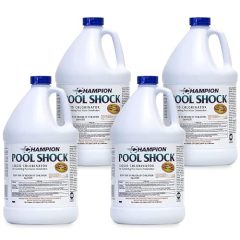 Liquid Chlorine / Sodium Hypochlorite (12.5%)
Everyday sanitizer — the B in BBB View on Amazon →
Liquid Chlorine / Sodium Hypochlorite (12.5%)
Everyday sanitizer — the B in BBB View on Amazon →
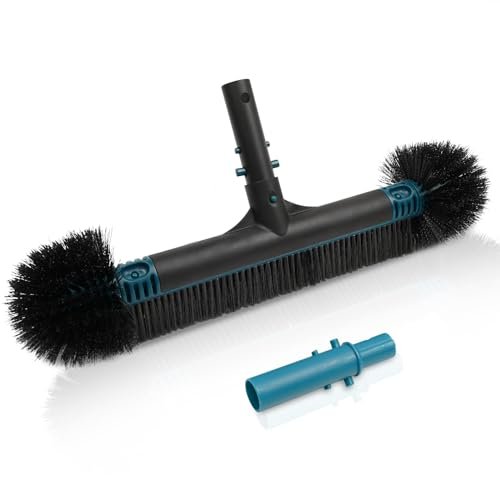 Poolvio 20" 2-in-1 Pool Brush Head (Walls & Floor)
Sturdy 20-inch brush head that clips onto any standard telescopic pole. View on Amazon →
Poolvio 20" 2-in-1 Pool Brush Head (Walls & Floor)
Sturdy 20-inch brush head that clips onto any standard telescopic pole. View on Amazon →
Still need help? Ask a Pool & Spa Expert AD
Get a personalized answer from PoolGuy810 — 30 years owning a pool and spa repair company. Describe your issue and get step-by-step help.
Related Pool Guides
Need More Help?
Try our free pool calculators and tools to help diagnose and fix your pool problems.
Browse Pool ToolsSLAM calculator, pH calculator, salt dosing & more