

Does Covering Pool Prevent Algae? Complete Prevention Guide

Will a pool cover actually stop algae or just pool store BS?
Read full question
I turned around at 2 AM to find my crystal-clear pool is now swamp green — desperately need to know if a cover will stop this algae disaster before tomorrow's party. The guys there keep pushing more and more expensive chemicals, and I swear they're just trying to upsell me on everything. Now they're telling me I need a pool cover to prevent algae, but I want to know if this actually works or if it's just another way to get money out of me.
I'm looking for honest advice here - does covering my pool genuinely prevent algae growth, or am I still going to need all those pricey chemicals even with a cover? I'd love to find some DIY solutions that actually work instead of constantly throwing money at this problem.
Quick Answer
Pool covers are highly effective at preventing algae by blocking sunlight and reducing debris, but they don't eliminate the need for proper chemical balance and filtration.
One caveat up front: a cover prevents algae — it won't clear a pool that's already green or rescue a party tomorrow. To clear existing green water you have to brush, run the filter continuously, and hold chlorine at SLAMShock Level And Maintain — raise free chlorine to a target based on your CYA and hold it there until the algae is gone. It's a process, not a one-time dose. the SLAM walkthrough → level (about 40% of your CYACyanuric Acid (stabilizer) — Sunscreen for your chlorine — it keeps sunlight from burning it off. The catch: the more you have, the more chlorine you need to keep. learn more →) until it clears; the cover keeps algae away afterward. And the real prevention is essentially free: keep your free chlorine at the right level for your CYA. A cover is a helpful add-on, not a required purchase.
How Pool Covers Prevent Algae
Pool covers work as algae prevention through multiple mechanisms that address the root causes of algae growth:
Sunlight Blocking
Algae are photosynthetic organisms that require sunlight to grow and multiply. A quality pool cover blocks 95-99% of UV rays, essentially starving algae of their primary energy source. This is particularly effective against green algae, which is the most common type in residential pools.
Debris Reduction
Covers prevent leaves, grass clippings, pollen, and other organic matter from entering your pool. These materials decompose and create nutrients (nitrates and phosphates) that feed algae growth. By blocking debris, you're eliminating a major food source for algae.
Chemical Conservation
Covers reduce chlorine loss from UV degradation by up to 90%. This means your sanitizer levels stay more consistent, maintaining the free chlorine at the right level for your CYA needed to prevent algae. With a Taylor K-2006 test kit, you'll notice chlorine levels dropping much slower with a cover on.
Types of Covers and Their Effectiveness
Solid Safety Covers
These provide the best algae prevention, blocking 100% of sunlight and debris. Mesh safety covers are less effective as they allow some debris and light penetration, but still offer significant protection.
Solar Covers
Blue solar covers are excellent for algae prevention while heating your pool. Clear covers heat better but allow more light penetration. For algae prevention specifically, choose blue or darker colored solar covers.
Automatic Covers
These solid covers provide excellent protection when closed but require consistent use to be effective. The convenience factor often leads to better algae prevention since owners use them more regularly.
When Covers Aren't Enough
Even with perfect cover usage, you still need proper water chemistry. Here's what to maintain:
Essential Chemical Balance
- Free Chlorine: scale it to your CYA (FCFree Chlorine — The chlorine actively sanitizing your water right now. This is the number you keep an eye on. how much you need → rises as CYA rises) — use the all-in-one pool calculator to get the target for your stabilizer level
- pH: 7.4-7.6 for comfort and balanced water
- Total Alkalinity: 80-120 ppm for regular pools, 60-80 for salt water
- Cyanuric Acid: 30-50 ppm for regular pools, 70-80 for salt water generators
Circulation Requirements
Run your pump 8-12 hours daily, even with a cover on. Stagnant water creates anaerobic conditions where certain algae types can still grow, particularly in dead spots behind ladders or in deep ends.
Cover Best Practices for Algae Prevention
- Remove covers weekly to test water chemistry with a reliable test kit like the Taylor K-2006
- Clean covers regularly to prevent algae growth on the cover itself from contaminating the pool
- Ensure proper water level - low water can create air pockets under solid covers where algae can grow
- Shock before covering for extended periods - raise FC to shock level (typically 40% of CYA) using liquid chlorine
- Add algaecide as backup - use algaecides like Polyquat 60 at manufacturer recommended rates (typically 2-4 oz per 10,000 gallons for initial treatment) before long-term covering
Troubleshooting Algae with Covers
If algae develops despite using a cover, check these common issues:
- Inadequate chlorine levels - Test FC daily when first using covers to establish proper dosing
- High phosphate levels - usually a red herring; if FC is held at the right level for your CYA, algae won't grow regardless of phosphates, so a phosphate remover is rarely necessary
- Poor filtration - Clean filters more frequently as covers can trap fine particles
- pH drift - Covered pools often see pH rise; adjust with muriatic acid as needed
Seasonal Considerations
During winter closings, covers are essential for algae prevention. Shock to your CYA-based SLAM level (about 40% of your CYA) and add a non-metallic Polyquat algaecide before covering. For summer use, remove covers at least twice weekly to maintain proper chemical balance and prevent equipment issues.
Safety Warning: Never add chemicals with the cover on, and always ensure proper ventilation when removing covers from chemically treated water.
For the full breakdown of safe chlorine levels by CYA level, see our pool water chemistry guide.
 Taylor K-2006C Complete FAS-DPD Pool & Spa Test Kit
The FAS-DPD kit pool pros trust — reads chlorine accurately even at shock/SLAM levels, plus pH, alkalinity, calcium hardness and CYA. View on Amazon →
Taylor K-2006C Complete FAS-DPD Pool & Spa Test Kit
The FAS-DPD kit pool pros trust — reads chlorine accurately even at shock/SLAM levels, plus pH, alkalinity, calcium hardness and CYA. View on Amazon →
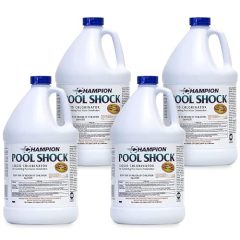 Liquid Chlorine / Sodium Hypochlorite (12.5%)
Everyday sanitizer — the B in BBB View on Amazon →
Liquid Chlorine / Sodium Hypochlorite (12.5%)
Everyday sanitizer — the B in BBB View on Amazon →
Still need help? Ask a Pool & Spa Expert AD
Get a personalized answer from PoolGuy810 — 30 years owning a pool and spa repair company. Describe your issue and get step-by-step help.
Related Pool Guides
Need More Help?
Try our free pool calculators and tools to help diagnose and fix your pool problems.
Browse Pool ToolsSLAM calculator, pH calculator, salt dosing & more