
DIY Pool Maintenance: Complete Guide for Beginners 2026

Can I handle all my pool maintenance myself as a total newbie?
Read full question
My newly inherited pool reeks of harsh chemicals and has this slimy algae scum floating on top, and I'm completely clueless about where to even begin. The previous owners left me with a bunch of chemicals and equipment but no instructions. My neighbors keep telling me I need to hire a pool service, but I'm wondering if I can figure this out on my own?
I'm pretty handy with other home maintenance stuff, but pools seem like they might be more complicated? What would I actually need to learn and what tools/supplies should I have on hand? Really trying to avoid turning my beautiful pool into a green swamp this summer!
Quick Answer
Yes, you can absolutely do your own pool maintenance with the right knowledge and tools. The key components are weekly water testing, proper chemical balancing, regular cleaning, and basic equipment maintenance.
Essential Knowledge for DIY Pool Maintenance
Understanding Pool Chemistry Fundamentals
The foundation of successful pool maintenance lies in understanding the relationship between key chemical parameters. Free Chlorine (FCFree Chlorine — The chlorine actively sanitizing your water right now. This is the number you keep an eye on. how much you need →) is your primary sanitizer, but its effectiveness depends heavily on your Cyanuric Acid (CYACyanuric Acid (stabilizer) — Sunscreen for your chlorine — it keeps sunlight from burning it off. The catch: the more you have, the more chlorine you need to keep. learn more →) level. CYA acts as sunscreen for chlorine but also reduces its effectiveness, requiring higher FC levels as CYA increases.
Target ranges for balanced water:
- Free Chlorine: Based on FC/CYAFC/CYA chart — The chart that sets your chlorine target from your stabilizer (CYA) level — the two go together. see the chart → relationship (typically 4-6 ppm for CYA 30-50)
- pH: 7.4-7.6 (ideal for comfort and chemical efficiency)
- Total Alkalinity: 80-120 ppm (60-80 for salt water pools)
- Cyanuric Acid: 30-50 ppm (70-80 for salt water generators)
- Calcium Hardness: 250-350 ppm for plaster, 175-225 ppm for vinyl/fiberglass
Required Testing Equipment
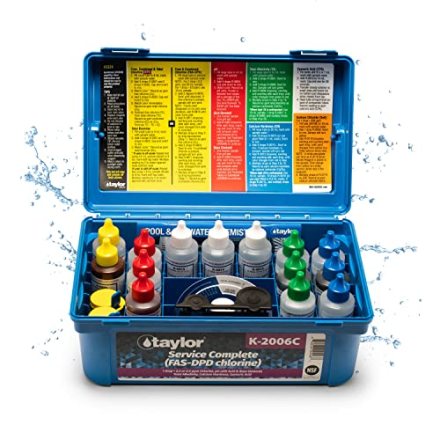
Invest in a quality test kit from the start. Taylor K-2006C FAS-DPDFAS-DPD test — A drop-based test that reads chlorine accurately even at high "shock" levels, where test strips give up. see test kits → test kit is the gold standard, providing accurate readings for all essential parameters. Avoid test strips for anything beyond quick checks - they're notoriously inaccurate for precise chemical balancing.
Weekly Maintenance Routine
Water Testing and Chemical Adjustment
- Test water parameters twice weekly, preferably evening after sun exposure
- Adjust pH first if outside 7.4-7.6 range using muriatic acid (lower) or soda ash (raise)
- Check and adjust Total Alkalinity if pH keeps drifting - use muriatic acid to lower, sodium bicarbonate to raise
- Maintain proper FC level based on your CYA reading using liquid chlorine (sodium hypochlorite)
Physical Cleaning Tasks
- Skim surface debris daily or every other day
- Brush walls and steps twice weekly, paying attention to corners and crevices
- Vacuum pool floor weekly or use automatic cleaner
- Empty skimmer and pump baskets weekly or as needed
- Clean waterline weekly with appropriate tile cleaner
Equipment Maintenance You Can Handle
Filter System Care
Cartridge filters: Rinse weekly with garden hose, deep clean monthly with filter cleaner, replace every 2-5 years or when pleated media shows wear or damage.
DE filters: Backwash when pressure rises 8-10 psi above clean pressure, add fresh DE powder after backwashing (typically 1 pound per 10 square feet of filter area - check manufacturer specifications).
Sand filters: Backwash weekly or when pressure increases, replace sand every 5-7 years or when water clarity suffers despite proper chemistry.
Salt Water Generator Maintenance
If you have a salt water pool, inspect the cell monthly for calcium buildup. Clean with muriatic acid solution (4:1 water to acid ratio) when buildup becomes visible. SAFETY CRITICAL: Always add acid to water, never water to acid, to prevent dangerous reactions. Always turn off power before removing cell.
Troubleshooting Common Issues
Cloudy Water Solutions
Cloudy water typically indicates filtration or sanitation problems. First, test all parameters and ensure FC is adequate for your CYA level. If chemistry is balanced but water remains cloudy, increase filtration time and consider using a clarifier or performing a SLAMShock Level And Maintain — raise free chlorine to a target based on your CYA and hold it there until the algae is gone. It's a process, not a one-time dose. the SLAM walkthrough → (Shock Level And Maintain) process.
Algae Prevention and Treatment
Prevention through consistent chlorine levels is far easier than treatment. If algae appears, perform SLAM process: raise FC to shock level based on CYA (typically 40% of CYA), brush vigorously, and maintain shock level until the water clears, combined chlorine (CCCombined Chlorine — "Used-up" chlorine left over from doing its job. Above about 0.5 ppm is the classic sign water needs a shock. learn more →) is 0.5 ppm or less, and the pool passes the overnight chlorine loss test.
When to Consider Professional Help
While most maintenance is DIY-friendly, certain situations warrant professional assistance:
- Equipment repairs requiring electrical work
- Major plumbing issues or leaks
- Severe algae blooms in expensive finishes
- Annual equipment inspections and tune-ups
- Opening/closing procedures in harsh climates
Cost Savings and Long-term Benefits
DIY maintenance typically costs $50-100 monthly in chemicals versus $100-200+ for professional service. More importantly, you'll develop intimate knowledge of your pool's behavior, catch problems early, and maintain consistently better water quality than most services provide.
Success requires consistency. Neglecting your pool for weeks then trying to fix everything at once leads to frustration and expensive chemical corrections. Stay on schedule, test regularly, and make small adjustments promptly.
For the full breakdown of safe chlorine levels by CYA level, see our pool water chemistry guide.
 Taylor K-2006C Complete FAS-DPD Pool & Spa Test Kit
The FAS-DPD kit pool pros trust — reads chlorine accurately even at shock/SLAM levels, plus pH, alkalinity, calcium hardness and CYA. View on Amazon →
Taylor K-2006C Complete FAS-DPD Pool & Spa Test Kit
The FAS-DPD kit pool pros trust — reads chlorine accurately even at shock/SLAM levels, plus pH, alkalinity, calcium hardness and CYA. View on Amazon →
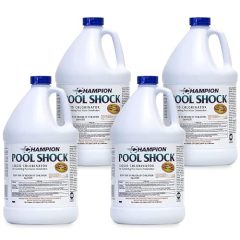 Liquid Chlorine / Sodium Hypochlorite (12.5%)
Everyday sanitizer — the B in BBB View on Amazon →
Liquid Chlorine / Sodium Hypochlorite (12.5%)
Everyday sanitizer — the B in BBB View on Amazon →
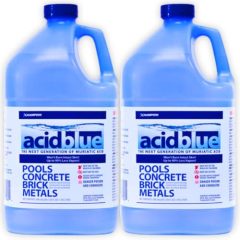 Acid Blue - Low Fume Muriatic Acid for Swimming Pools & Spas - Lower's pH, Reduces Alkalinity - 2 Gallon
View on Amazon →
Acid Blue - Low Fume Muriatic Acid for Swimming Pools & Spas - Lower's pH, Reduces Alkalinity - 2 Gallon
View on Amazon →
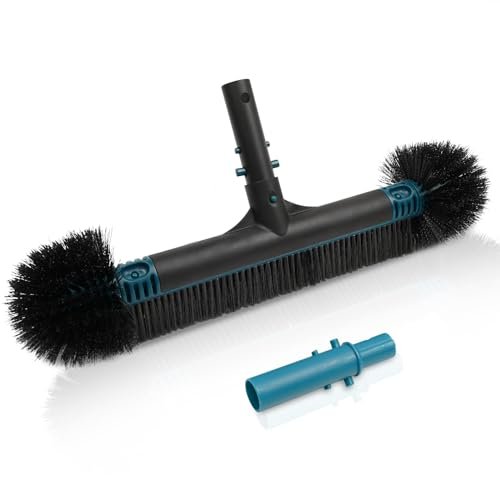 Poolvio 20" 2-in-1 Pool Brush Head (Walls & Floor)
Sturdy 20-inch brush head that clips onto any standard telescopic pole. View on Amazon →
Poolvio 20" 2-in-1 Pool Brush Head (Walls & Floor)
Sturdy 20-inch brush head that clips onto any standard telescopic pole. View on Amazon →
Still need help? Ask a Pool & Spa Expert AD
Get a personalized answer from PoolGuy810 — 30 years owning a pool and spa repair company. Describe your issue and get step-by-step help.
Need More Help?
Try our free pool calculators and tools to help diagnose and fix your pool problems.
Browse Pool ToolsSLAM calculator, pH calculator, salt dosing & more