
Can You Shock Pool After Adding Stabilizer? Complete Guide

When can I shock my pool after adding stabilizer?
Read full question
Apparently I added stabilizer to my pool yesterday but now I'm second-guessing whether it's safe to shock it — did I mess up the timing? The pool store told me I needed it because my chlorine wasn't lasting very long in the sun. Now I'm wondering when it's safe to shock the pool - can I do it right away or do I need to wait?
I've heard that stabilizer takes time to dissolve and I don't want to mess up the chemical balance. Should I test the CYA levels first? And does having stabilizer in the water change how much shock I should use? Any guidance would be really appreciated!
Quick Answer
Yes, you can shock your pool after adding stabilizer — you don't have to wait. Just know granular CYA dissolves slowly and reads low for several days, so don't size your shock off a too-early CYA test. Use the actual CYA level (or our all-in-one pool calculator) to estimate the free chlorine via the FC/CYA relationship.
Step-by-Step Process for Shocking After Adding Stabilizer
- Wait for stabilizer to fully dissolve
Allow 24-48 hours after adding stabilizer before shocking. Cyanuric acid dissolves slowly and needs time to circulate throughout your pool. Keep your pump running continuously during this period to ensure proper mixing. - Test your current CYACyanuric Acid (stabilizer) — Sunscreen for your chlorine — it keeps sunlight from burning it off. The catch: the more you have, the more chlorine you need to keep. learn more → level
Use a reliable test kit like the Taylor K-2006 to measure your cyanuric acid level. Don't rely on test strips for CYA readings as they're notoriously inaccurate. Your target CYA should be 30-50 ppm for regular chlorine pools or 70-80 ppm for salt water generator pools. - Test current free chlorine (FCFree Chlorine — The chlorine actively sanitizing your water right now. This is the number you keep an eye on. how much you need →) level
Measure your existing FC level using the FAS-DPDFAS-DPD test — A drop-based test that reads chlorine accurately even at high "shock" levels, where test strips give up. see test kits → test method. This gives you a baseline to work from when calculating your shock dosage. - Determine your shock level using FC/CYAFC/CYA chart — The chart that sets your chlorine target from your stabilizer (CYA) level — the two go together. see the chart → ratio
Consult the FC/CYA relationship — our all-in-one pool calculator estimates the free chlorine target for your CYA. For algae treatment (SLAMShock Level And Maintain — raise free chlorine to a target based on your CYA and hold it there until the algae is gone. It's a process, not a one-time dose. the SLAM walkthrough → method), you need FC at shock level, which is typically 40% of your CYA level. For example, if your CYA is 50 ppm, your shock level should be 20 ppm FC. - Calculate required chlorine amount
???? For a quick estimate, our all-in-one pool calculator gives the amount of chlorine to add based on your pool size and your current vs. target FC levels. It's a handy reference to get the right dose.
Subtract your current FC from your target shock level to find how much to add. Use liquid chlorine (sodium hypochlorite) for best results. - Add liquid chlorine gradually
Pour liquid chlorine around the pool perimeter while the pump is running. Never add all at once in one spot. If adding large amounts, do it in the evening to prevent sun degradation. - Maintain circulation
Run your pump continuously while shocking. Proper circulation ensures even distribution and prevents chlorine pockets that could damage pool surfaces. - Test and maintain shock level
Test FC levels every few hours and add more chlorine as needed to maintain shock level. If you're doing a SLAM process, maintain shock level until you can hold it overnight and pass the Overnight Chlorine Loss Test (OCLT). - Monitor pH levels
Shocking can raise pH, so test and adjust if necessary. Ideal pH range is 7.4-7.6. Use muriatic acid to lower pH if it rises above 7.8. - Continue until clear
If treating algae or cloudy water, maintain shock level until the water is crystal clear, combined chlorine (CCCombined Chlorine — "Used-up" chlorine left over from doing its job. Above about 0.5 ppm is the classic sign water needs a shock. learn more →) is 0.5 ppm or less, and you pass the OCLT. This proves your pool is sanitized and ready for normal operation.
Important Considerations When Shocking After Adding Stabilizer
Timing Is Critical
The 24-48 hour waiting period isn't just a suggestion - it's essential for accurate chemical balance. Adding shock before stabilizer fully dissolves can lead to:
- Inaccurate CYA readings leading to improper shock dosage
- Potential over-chlorination or under-chlorination
- Wasted chemicals and money
- Possible surface staining from undissolved stabilizer
Dosage Adjustments
Higher CYA levels mean you need higher chlorine levels to achieve the same sanitizing effect. This is because stabilizer binds with chlorine, creating a reserve but reducing active sanitization. Always use the FC/CYA relationship — our all-in-one pool calculator estimates the free chlorine target for your CYA. It's based on scientific research and pool industry best practices.
Safety Precautions
Never mix chemicals directly. Always add chemicals to water, never water to chemicals. Store chemicals in a cool, dry place away from other pool chemicals. When handling liquid chlorine, wear gloves and eye protection, and ensure adequate ventilation.
Common Mistakes to Avoid
- Shocking too soon: Adding shock before stabilizer dissolves leads to inaccurate chemical readings and poor results
- Confusing cal-hypo with stabilized shock: cal-hypo adds calcium, not stabilizer — it is dichlor and trichlor that raise CYA over time
- Not testing CYA accurately: Test strips are unreliable for CYA - invest in a quality liquid test kit
- Ignoring the FC/CYA ratio: This scientific relationship is crucial for effective sanitization
- Adding shock during peak sun hours: UV rays break down chlorine rapidly - shock in the evening for best results
Monitoring and Maintenance
After shocking, continue testing daily until levels stabilize. Your pool should maintain the proper FC level based on your CYA reading. For ongoing maintenance, liquid chlorine is a great default because it adds only chlorine — no calcium (cal-hypo) or CYA (dichlor) building up over time. Cal-hypo is still a fine shock if your calcium is low, and dichlor is useful if your CYA needs raising.
Remember that stabilizer is very stable - it breaks down only slowly, and mostly leaves your pool through dilution (backwashing, splash-out, rain overflow). If CYA gets too high (over 80-100 ppm), you'll need to partially drain and refill your pool to bring levels down.
For the full breakdown of safe chlorine levels by CYA level, see our pool water chemistry guide.
 Taylor K-2006C Complete FAS-DPD Pool & Spa Test Kit
The FAS-DPD kit pool pros trust — reads chlorine accurately even at shock/SLAM levels, plus pH, alkalinity, calcium hardness and CYA. View on Amazon →
Taylor K-2006C Complete FAS-DPD Pool & Spa Test Kit
The FAS-DPD kit pool pros trust — reads chlorine accurately even at shock/SLAM levels, plus pH, alkalinity, calcium hardness and CYA. View on Amazon →
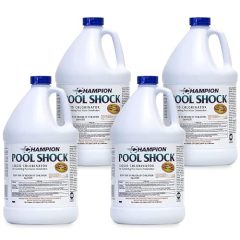 Liquid Chlorine / Sodium Hypochlorite (12.5%)
Everyday sanitizer — the B in BBB View on Amazon →
Liquid Chlorine / Sodium Hypochlorite (12.5%)
Everyday sanitizer — the B in BBB View on Amazon →
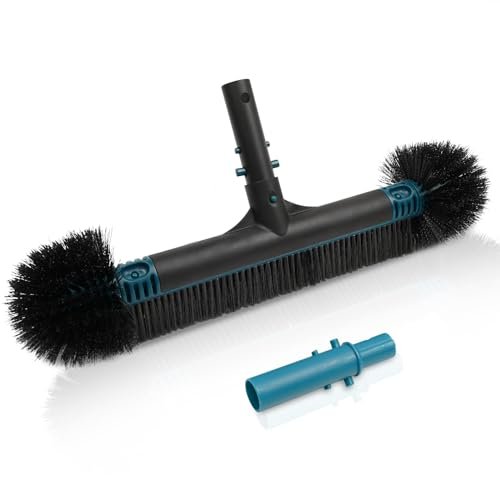 Poolvio 20" 2-in-1 Pool Brush Head (Walls & Floor)
Sturdy 20-inch brush head that clips onto any standard telescopic pole. View on Amazon →
Poolvio 20" 2-in-1 Pool Brush Head (Walls & Floor)
Sturdy 20-inch brush head that clips onto any standard telescopic pole. View on Amazon →
Still need help? Ask a Pool & Spa Expert AD
Get a personalized answer from PoolGuy810 — 30 years owning a pool and spa repair company. Describe your issue and get step-by-step help.
Related Pool Guides
Need More Help?
Try our free pool calculators and tools to help diagnose and fix your pool problems.
Browse Pool ToolsSLAM calculator, pH calculator, salt dosing & more