
How Long Pool Heaters Take to Heat Up - Complete Guide

Pool heating times - gas vs heat pump reality check?
Read full question
After years of relying on my old gas heater's predictable 24-hour heating schedule, this new heat pump is throwing me completely off track. They keep pushing expensive systems without giving me straight answers about actual heating performance. I need to know the real deal on how long different heater types actually take to warm up a pool.
Specifically, what's the realistic heating rate for gas heaters versus heat pumps? I keep hearing conflicting info and I'm trying to make an informed decision without getting upsold on features I don't need. Just want honest numbers on temperature rise per hour so I can figure out what works for my situation and budget.
Quick Answer
Pool heating time depends on heater type, pool size, and temperature difference. Gas heaters are the fastest, typically raising temperature 1-2°F per hour, while heat pumps are slower and steadier at roughly 0.5-1.5°F per hour on smaller pools.
Heating Time by Pool Heater Type
Gas Pool Heaters
Gas heaters are the workhorses of pool heating, offering consistent performance regardless of ambient temperature. A properly sized gas heater (400,000 BTU for a 20,000-gallon pool) will raise water temperature approximately 1-2°F per hour of continuous operation.
For a typical scenario - heating a 15,000-gallon pool from 70°F to 82°F (12-degree increase) - expect 6-12 hours with a 300,000-400,000 BTU gas heater. Wondering why 82°F is the usual target? See our guide to the ideal pool temperature. Larger pools or greater temperature differences require proportionally more time.
Heat Pump Pool Heaters
Heat pumps extract warmth from ambient air, making their efficiency highly temperature-dependent. In optimal conditions (80°F+ ambient temperature), a correctly sized heat pump can raise pool temperature 1-2°F per hour for pools under 10,000 gallons.
However, heat pump performance drops dramatically as ambient temperature decreases. At 60°F ambient temperature, expect heating rates to drop to 0.5-1°F per hour. Below 50°F ambient temperature, most heat pumps become ineffective.
Electric Resistance Heaters
Electric resistance heaters heat consistently regardless of weather, with the rate scaling to the unit's wattage. However, their high operating costs make them best suited to spas or small pools, though large units exist: a 57kW electric heater on a 12,000-gallon pool typically achieves about 1.5-2°F per hour.
Factors Affecting Heating Time
Pool Size and Volume
Water volume directly impacts heating time. Calculate your pool volume: Length × Width × Average Depth × 7.48 = Gallons. A 16×32 pool with 4-foot average depth contains approximately 15,400 gallons. Doubling the volume doubles the heating time with the same BTU output.
Heater Size and BTU Output
Proper heater sizing is crucial for reasonable heating times. The industry standard recommends 50,000 BTU per 10,000 gallons of pool water in moderate climates, or 75,000 BTU per 10,000 gallons in colder regions or for faster heating.
Undersized heaters result in frustratingly long heating times and may never reach desired temperatures in cooler weather.
Starting Water Temperature
The temperature differential between current and target temperatures determines total heating time. Heating from 65°F to 80°F (15-degree increase) takes significantly longer than maintaining temperature or adding a few degrees.
Heat Loss Factors
Several factors accelerate heat loss during heating:
- Wind speed - increases evaporation and convective heat loss
- Ambient air temperature - greater differential increases heat loss rate
- Pool surface area - larger surfaces lose heat faster
- Humidity levels - low humidity increases evaporation
- Pool cover usage - can reduce heating time by 50-70%
Calculating Your Pool's Heating Time
To estimate warm-up time for your pool, use our heater warm-up calculator — it works the hours out from your pool volume, the temperature rise you want, and your heater's BTU output.
To do the math by hand: Hours = (Gallons × 8.34 × °F rise) ÷ (BTU output × 0.80). One gallon of water weighs 8.34 pounds, and one BTU raises one pound of water 1°F.
Example: 20,000-gallon pool, 10°F rise, 400,000 BTU heater: 20,000 × 8.34 × 10 = 1,668,000 BTU needed, ÷ (400,000 × 0.80) = about 5.2 hours of continuous heating.
The 0.80 factor accounts for heater efficiency and heat loss during operation.
Optimizing Heating Performance
Use a Pool Cover
Pool covers are the single most effective way to reduce heating time. A quality solar cover or automatic cover can reduce heating time by 50-70% by minimizing evaporation and heat loss.
Windbreaks and Landscaping
Strategic landscaping or temporary windbreaks reduce wind-driven heat loss. Even modest wind reduction can improve heating efficiency by 20-30%.
Proper Water Chemistry
Maintain proper water chemistry to ensure efficient heat transfer. Scale buildup on heat exchanger surfaces reduces efficiency significantly. Keep calcium hardness between 200-300 ppm, pH between 7.4-7.6, and total alkalinity between 80-120 ppm.
Regular Maintenance
Clean heat exchangers and maintain proper water flow rates. Restricted flow reduces heat transfer efficiency and extends heating times.
Common Heating Mistakes to Avoid
Never run your heater with improper water chemistry, as scale buildup can damage expensive heat exchanger components. Test water weekly during heating season and adjust as needed.
Avoid oversized heaters for your electrical or gas supply capacity. An undersized gas line or electrical service will prevent the heater from reaching rated output.
Don't expect consistent performance from heat pumps in cool weather. Heat pumps work best in temperatures above 70°F and become increasingly inefficient below 60°F.
When to Call a Professional
Contact a pool professional if your heater takes significantly longer than calculated times, fails to maintain temperature, or shows error codes. These symptoms often indicate sizing problems, mechanical issues, or installation defects requiring expert diagnosis.
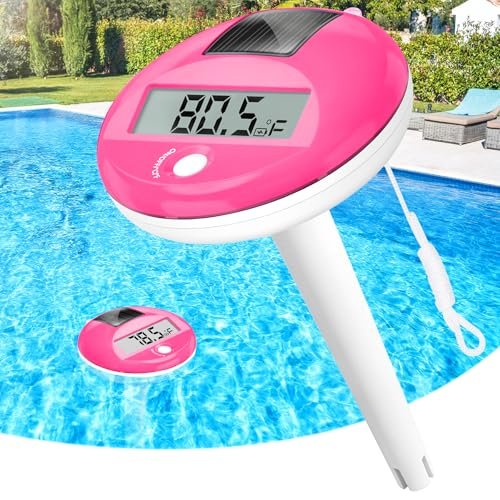 LuxBlue Floating Pool Thermometer, Solar, Large LCD
Easy-read floating thermometer for pool water temperature. View on Amazon →
LuxBlue Floating Pool Thermometer, Solar, Large LCD
Easy-read floating thermometer for pool water temperature. View on Amazon →
 Taylor K-2006C Complete FAS-DPD Pool & Spa Test Kit
The FAS-DPD kit pool pros trust — reads chlorine accurately even at shock/SLAM levels, plus pH, alkalinity, calcium hardness and CYA. View on Amazon →
Taylor K-2006C Complete FAS-DPD Pool & Spa Test Kit
The FAS-DPD kit pool pros trust — reads chlorine accurately even at shock/SLAM levels, plus pH, alkalinity, calcium hardness and CYA. View on Amazon →
Still need help? Ask a Pool & Spa Expert AD
Get a personalized answer from PoolGuy810 — 30 years owning a pool and spa repair company. Describe your issue and get step-by-step help.
Related Pool Guides
Need More Help?
Try our free pool calculators and tools to help diagnose and fix your pool problems.
Browse Pool ToolsSLAM calculator, pH calculator, salt dosing & more