
Do I Need a Sand Filter for My Pool? Complete Guide

What type of filter should I get for my pool setup?
Read full question
Since my pool water keeps turning cloudy even after cleaning, is it dangerous for my kids who swim almost daily? My pool has been a constant headache and I'm wondering if switching to a sand filter would solve my problems, or if there are better options out there.
I keep hearing different things - some people swear by sand filters because they're supposedly low-maintenance, others say cartridge or DE filters work better. My pool isn't huge but gets decent use, and honestly I just want something that actually works without me having to mess with it constantly. What's the real deal with these different filter types and how do I know which one would work best for my situation?
Quick Answer
You don't necessarily need a sand filter for your pool - cartridge and DE filters are also effective options. Sand filters are popular for their low maintenance and cost-effectiveness, but the best choice depends on your pool size, usage, and maintenance preferences.
Is cloudy water dangerous for kids? It can be - persistent cloudiness usually means sanitation has slipped (free chlorine too low for your CYACyanuric Acid (stabilizer) — Sunscreen for your chlorine — it keeps sunlight from burning it off. The catch: the more you have, the more chlorine you need to keep. learn more →), and it cuts visibility, which is itself a drowning hazard. So before assuming you need a different filter, confirm your FCFree Chlorine — The chlorine actively sanitizing your water right now. This is the number you keep an eye on. how much you need →-to-CYA balance; cloudiness is more often a chemistry problem than a filter problem.
Understanding Your Pool Filtration Options
Every pool requires some form of filtration system to remove debris, contaminants, and particles from the water. The three main types of pool filters are:
- Sand filters - Use specially graded silica sand to trap particles
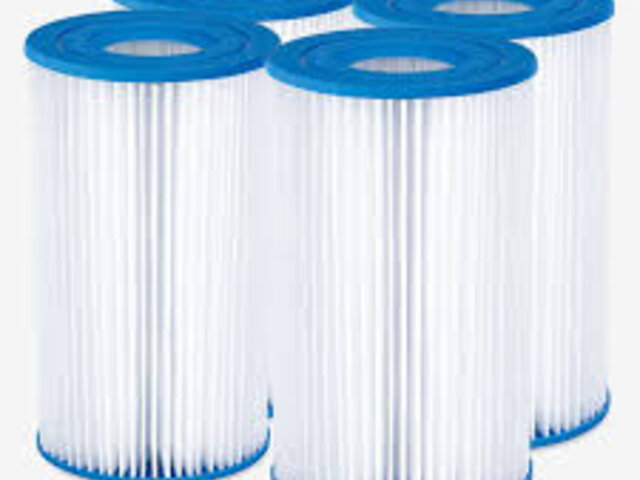
- Cartridge filters - Use pleated fabric cartridges to filter water
- Diatomaceous Earth (DE) filters - Use fossilized diatoms for finest filtration
When Sand Filters Make Sense
Ideal Pool Situations for Sand Filters
Sand filters work exceptionally well for:
- Pools larger than 15,000 gallons where cartridge replacement costs become significant
- High-bather load pools that generate more contaminants
- Pools in areas with heavy debris (leaves, pollen, dust)
- Owners who prefer simple backwashing to hosing off cartridge elements (all filter types work fine on salt pools)
- Pool owners who prefer minimal hands-on maintenance
Advantages of Sand Filtration
Sand filters offer several compelling benefits:
- Low ongoing costs - Sand typically lasts 5-7 years, while cartridge elements last 2-5 years
- Easy maintenance - Simple backwashing process cleans the filter
- High flow rates - Handle large volumes of water efficiently
- Durability - Fewer moving parts mean less potential for breakdown
- Effective particle removal - Filter particles down to 20-40 microns
When You Might Skip Sand Filters
Situations Favoring Cartridge Filters
Consider cartridge filters instead if you have:
- Smaller pools under 10,000 gallons where cartridge costs are manageable
- Limited space for equipment, as cartridge systems are more compact
- Desire for finer filtration (cartridges filter to 10-15 microns)
- Preference for no backwashing water waste
- Pools with minimal debris and low bather loads
When DE Filters Are Superior
Diatomaceous earth filters excel when:
- Crystal-clear water is the top priority (filters to 2-5 microns)
- You're willing to invest time in more complex maintenance
- Pool has specific water clarity challenges
- You don't mind higher ongoing costs for DE powder
Sand Filter Requirements and Considerations
Proper Sizing
If you choose a sand filter, proper sizing is crucial. The filter should turn over your entire pool volume in 6-8 hours. For example, a 20,000-gallon pool needs a pump and filter system capable of moving 2,500-3,300 gallons per hour. Undersized sand filters will require more frequent backwashing and provide inadequate filtration.
Sand Quality Matters
Use only #20 silica sand specifically designed for pool filters. This sand is graded to roughly 0.45-0.55mm particle size for optimal filtration. Avoid play sand, construction sand, or other alternatives that can damage your system or provide poor filtration.
Maintenance Requirements
Sand filters require regular backwashing when the pressure gauge reads 8-10 PSI above the clean starting pressure. This typically occurs every 2-4 weeks depending on pool usage and debris load. The backwashing process uses 200-400 gallons of water, which may be a consideration in drought-prone areas.
Integration with Pool Chemistry
Regardless of your filter choice, proper water chemistry is essential. Sand filters work best when:
- pH is maintained between 7.4-7.6 for water balance and comfort (pH has little effect on a sand filter's mechanical performance)
- Total alkalinity stays within 80-120 ppm for regular chlorine or 80-120 ppm for salt water generators
- Free chlorine levels match your cyanuric acid (CYA) levels according to the FC/CYAFC/CYA chart — The chart that sets your chlorine target from your stabilizer (CYA) level — the two go together. see the chart → chart
- Calcium hardness remains at 250-350 ppm for plaster pools
Important: Poor water chemistry can cause sand channeling, where water creates pathways through the sand bed, reducing filtration effectiveness. Regular testing with a quality test kit like the Taylor K-2006 helps prevent these issues.
Making Your Decision
To determine if you need a sand filter, evaluate:
- Your pool size and typical bather load
- Available space for equipment
- Maintenance preferences and time availability
- Local water restrictions that might limit backwashing
- Long-term operating cost considerations
- Desired water clarity standards
Sand filters are a solid middle-ground choice for most pool owners - though because sand is the coarsest medium (20-40 microns), switching TO sand is unlikely to cure cloudiness (cartridge or DE polishes finer), and persistent cloudiness should first be diagnosed as a chemistry vs. filtration question, offering reliable performance with minimal fuss. However, they're not mandatory - cartridge and DE systems can provide equally effective filtration when properly matched to your specific situation and maintained correctly.
For the full breakdown of safe chlorine levels by CYA level, see our pool water chemistry guide.
 Taylor K-2006C Complete FAS-DPD Pool & Spa Test Kit
The FAS-DPD kit pool pros trust — reads chlorine accurately even at shock/SLAM levels, plus pH, alkalinity, calcium hardness and CYA. View on Amazon →
Taylor K-2006C Complete FAS-DPD Pool & Spa Test Kit
The FAS-DPD kit pool pros trust — reads chlorine accurately even at shock/SLAM levels, plus pH, alkalinity, calcium hardness and CYA. View on Amazon →
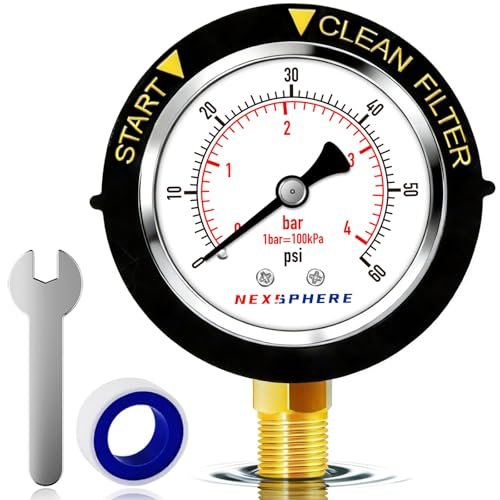 NexSphere Pool Filter Pressure Gauge, 0–60 PSI, 2 in Dial
Replacement back-mount gauge so you can read filter pressure and know when to backwash. View on Amazon →
NexSphere Pool Filter Pressure Gauge, 0–60 PSI, 2 in Dial
Replacement back-mount gauge so you can read filter pressure and know when to backwash. View on Amazon →
Still need help? Ask a Pool & Spa Expert AD
Get a personalized answer from PoolGuy810 — 30 years owning a pool and spa repair company. Describe your issue and get step-by-step help.
Related Pool Guides
Need More Help?
Try our free pool calculators and tools to help diagnose and fix your pool problems.
Browse Pool ToolsSLAM calculator, pH calculator, salt dosing & more