
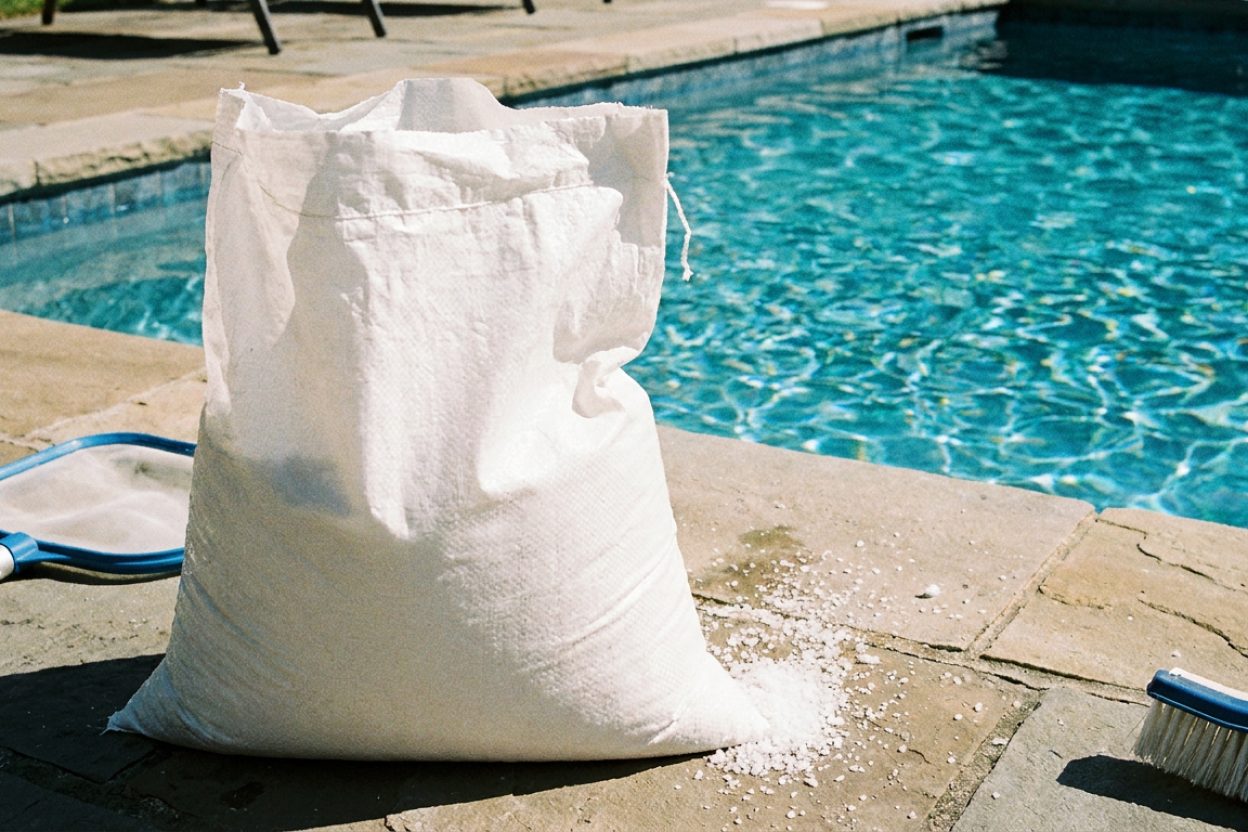
Do You Need Cyanuric Acid in a Saltwater Pool? Complete Guide

Is cyanuric acid really necessary for saltwater pools?
Read full question
Somewhere around midnight my saltwater pool's chlorine levels just crashed — need to figure out if cyanuric acid will fix this before the pool guy comes tomorrow. The pool store keeps pushing me to buy their stabilizer products, claiming it's essential, but I'm suspicious they're just trying to upsell me on expensive chemicals I don't really need.
I thought the whole point of having a salt system was to avoid all these extra chemical additions and maintenance headaches. My chlorine generator seems to be working fine, so do I really need to spend money on cyanuric acid? What levels should I be targeting if it's actually necessary, and can I add it myself instead of paying pool store prices?
Quick Answer
Outdoor saltwater pools do need cyanuric acid (about 70-80 ppm) — the salt cell makes unstabilized chlorine that UV destroys within hours, so CYA shields it. Indoor salt pools are the exception: with no sunlight they need little to none (0-20 ppm); the usual 70-80 ppm just suppresses chlorine for no benefit.
Why Outdoor Saltwater Pools Need Stabilizer
Your salt cell converts dissolved salt into chlorine (the same active sanitizer as liquid chlorine) through electrolysis, and that chlorine is completely unstabilized. Without cyanuric acid protection, UV rays will destroy up to 90% of your free chlorine within 2-3 hours of direct sunlight. This forces your salt cell to work overtime, leading to premature failure and higher electricity costs.
The cyanuric acid forms a weak bond with chlorine molecules, creating a protective shield against UV degradation while still allowing the chlorine to sanitize effectively. This is why pools with proper CYACyanuric Acid (stabilizer) — Sunscreen for your chlorine — it keeps sunlight from burning it off. The catch: the more you have, the more chlorine you need to keep. learn more → levels can maintain consistent chlorine readings even during peak summer sun.
Optimal CYA Levels for Salt Water Pools
Saltwater pools require higher cyanuric acid levels than traditional pools:
- Outdoor saltwater pools: 70-80ppm (some go up to 90ppm)
- Traditional chlorine pools: 30-50ppm
- Indoor pools (including indoor salt): little to none — 0-20ppm, since there’s no UV to guard against
The higher range compensates for the constant chlorine production and helps maintain proper free chlorine to cyanuric acid ratios. Use the FC/CYAFC/CYA chart — The chart that sets your chlorine target from your stabilizer (CYA) level — the two go together. see the chart → chart to determine your target free chlorine level based on your CYA reading.
How to Add Cyanuric Acid to Your Saltwater Pool
Our all-in-one pool calculator gives a quick estimate of the amount of cyanuric acid to add based on your pool size and current vs. target CYA levels, with no manual calculation needed.
To do it by hand (note that actual amounts vary with product concentration, so the calculator is more reliable): Add about 1 pound of cyanuric acid per 10,000 gallons to raise CYA by roughly 12 ppm. For a 20,000-gallon pool going from 0 to 70 ppm, that's about 12 pounds of stabilizer — but add conservatively and retest, since CYA is hard to remove once it's in.
Follow these steps for proper addition:
- Test current CYA levels using a Taylor K-2006 test kit
- Use the calculator to size the dose for your pool volume
- Add the cyanuric acid in a sock or old nylon stocking placed in the skimmer basket (or hung in front of a return jet) and let the pump run. CYA dissolves very slowly, so the sock keeps undissolved granules from settling on the pool floor, where they can bleach or etch the surface
- Give it several days to fully dissolve and register on a test — CYA is notoriously slow and can take most of a week to show up
- Wait at least 3-5 days before retesting and adding any more (testing too early reads low and tempts you to over-add)
Safety warning: Don't broadcast dry cyanuric acid onto the pool floor (it dissolves slowly and can bleach or etch the surface) and never mix it with other chemicals. Use the sock-in-skimmer method with circulation running, and don't backwash or clean the filter for several days while it dissolves.
Testing and Monitoring CYA Levels
Test cyanuric acid levels monthly during swimming season and after heavy rainfall or significant water loss. The Taylor K-2006 test kit provides the most accurate CYA readings; test strips are notoriously weak for CYA specifically, so use a liquid reagent kit when you need a reliable number.
Signs your CYA may be too low include:
- Difficulty maintaining chlorine levels despite proper salt cell operation
- Chlorine readings that drop dramatically after sunny days
- Salt cell running constantly at high output
- Higher than normal electricity costs
Common Saltwater Pool CYA Mistakes
Many saltwater pool owners make these critical errors:
Assuming stabilizer isn't needed: Some believe salt cells produce "different" chlorine that doesn't need protection. All chlorine needs UV protection regardless of source — so if your pool gets sunlight, it needs CYA (an indoor pool is the one case that doesn’t).
Using stabilized (dichlor/trichlor) shock: The products that over-stabilize are dichlor and trichlor — they're stabilized chlorine and add CYA every time you use them. Cal-hypo and liquid chlorine add none, so the rule isn't "avoid shock," it's "avoid dichlor and trichlor when you're watching CYA." For a salt pool, liquid chlorine is the best choice for shocking — no CYA, and no calcium to scale your cell.
Ignoring the FC/CYA relationship: Higher CYA requires proportionally higher free chlorine levels. At 80 ppm CYA, keep free chlorine around 5 ppm minimum — salt pools follow the SWGSalt Water Generator — The "salt cell" that makes chlorine from the salt in a saltwater pool. Same chlorine — it just makes its own. pool terms → FC/CYA chart; for the recommended 70-80 ppm CYA, keep FCFree Chlorine — The chlorine actively sanitizing your water right now. This is the number you keep an eye on. how much you need → in the 5-10 ppm range (never below 5) (target roughly 5-10 ppm). Set FC from the chart, not a flat number.
Reducing High Cyanuric Acid Levels
Unlike most other pool chemicals, cyanuric acid breaks down only very slowly. If levels exceed 100ppm, you'll need to dilute by draining and refilling portions of your pool water. Plan for 25-30% annual water replacement to prevent CYA creep.
Consider using a reverse osmosis mobile service for partial water changes, which removes CYA while maintaining proper water balance chemistry.
Seasonal Considerations
CYA levels become more critical during peak summer months when UV intensity is highest. Spring opening often requires CYA adjustment after winter dilution from snow, rain, or cover pump-outs. Test and adjust early in the season before UV exposure becomes intense.
During winter months in warmer climates, you can operate with slightly lower CYA levels (60-70ppm) since UV intensity decreases, but maintain adequate protection for your salt cell's chlorine production.
For the full breakdown of safe chlorine levels by CYA level, see our pool water chemistry guide.
 Taylor K-2006C Complete FAS-DPD Pool & Spa Test Kit
The FAS-DPD kit pool pros trust — reads chlorine accurately even at shock/SLAM levels, plus pH, alkalinity, calcium hardness and CYA. View on Amazon →
Taylor K-2006C Complete FAS-DPD Pool & Spa Test Kit
The FAS-DPD kit pool pros trust — reads chlorine accurately even at shock/SLAM levels, plus pH, alkalinity, calcium hardness and CYA. View on Amazon →
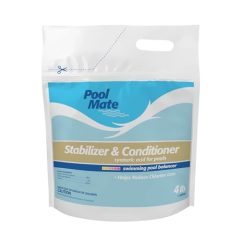 Pool Mate 4-Pounds Premium Pool Stabilizer and Conditioner, Concentrated Cyanuric Acid for Pools, Helps Chlorine Last Longer
View on Amazon →
Pool Mate 4-Pounds Premium Pool Stabilizer and Conditioner, Concentrated Cyanuric Acid for Pools, Helps Chlorine Last Longer
View on Amazon →
Still need help? Ask a Pool & Spa Expert AD
Get a personalized answer from PoolGuy810 — 30 years owning a pool and spa repair company. Describe your issue and get step-by-step help.
Related Pool Guides
Need More Help?
Try our free pool calculators and tools to help diagnose and fix your pool problems.
Browse Pool ToolsSLAM calculator, pH calculator, salt dosing & more