For informational purposes only. Information may not be complete or accurate. Always verify before use. For complex pool issues, consult a qualified pool professional. See our Terms of Service.

How to Determine Your Swimming Pool Size & Volume

Maintenance Easy 30 minutes 3 views

How do I figure out my pool's actual size and volume?

I just became a pool owner and I'm pretty overwhelmed with all the maintenance stuff. The pool store told me I need to know my exact pool volume to add the right amount of chemicals, but I'm not sure how to calculate that properly.

My pool is rectangular, but I've seen some formulas online and I'm getting confused about whether I'm doing the math right. Do I just measure length times width, or is there more to it? I want to make sure I get this right so I don't mess up the chemical balance.

Dear Rachel L.,

Quick Answer

To determine your pool size, measure length × width × average depth × 7.5 for rectangular pools, or use specific formulas for round/oval pools. Knowing your exact volume is crucial for proper chemical dosing.

Tools & Supplies Needed

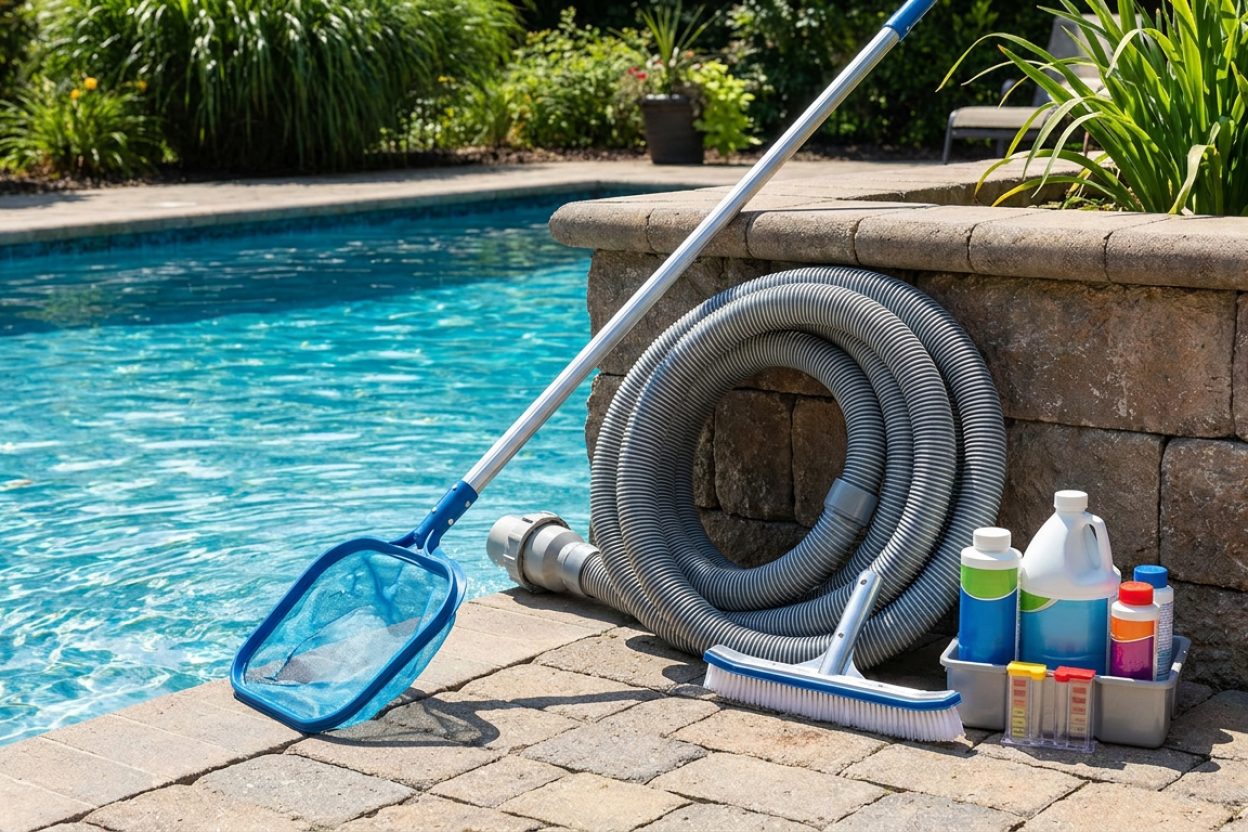
measuring tape (50+ feet) calculator pen and paper laser measuring device (optional)

Find on Amazon: 100ft Measuring Tape , Laser Distance Meter , Waterproof Calculator

Quick Answer

Determining your pool size requires measuring its dimensions and calculating the total volume in gallons. For rectangular pools, multiply length × width × average depth × 7.5. Round pools use diameter × diameter × average depth × 5.9. Knowing your exact pool volume is essential for proper chemical dosing, equipment sizing, and maintenance scheduling.

Step-by-Step Pool Size Calculation

  1. Gather Your Measuring Tools
    You'll need a measuring tape (preferably 50+ feet), calculator, pen and paper. A laser measuring device can make this easier for larger pools. For safety, ensure the pool area is well-lit and surfaces aren't slippery.
  2. Measure Pool Length
    Measure the longest dimension of your pool from one end to the other. For rectangular pools, this is straightforward. For irregular shapes, measure the longest point. Record this measurement in feet and inches, then convert to decimal feet (e.g., 32 feet 6 inches = 32.5 feet).
  3. Measure Pool Width
    Measure the widest point perpendicular to the length. For kidney-shaped or irregular pools, measure the widest section. Again, record in decimal feet format for easier calculation.
  4. Determine Average Depth
    This is the trickiest measurement. Add your shallow end depth plus deep end depth, then divide by 2. For example: shallow end 3 feet + deep end 8 feet = 11 feet ÷ 2 = 5.5 feet average depth. For pools with gradual slopes, take measurements at 3-4 points and average them.
  5. Apply the Correct Formula
    Use these formulas based on your pool shape:
    • Rectangular: Length × Width × Average Depth × 7.5 = Total Gallons
    • Round: Diameter × Diameter × Average Depth × 5.9 = Total Gallons
    • Oval: Length × Width × Average Depth × 6.7 = Total Gallons
    • Kidney/Irregular: Length × Width × Average Depth × 7.0 = Total Gallons (approximate)
  6. Calculate Your Pool Volume
    Let's use an example: 32-foot long × 16-foot wide × 5.5-foot average depth rectangular pool = 32 × 16 × 5.5 × 7.5 = 21,120 gallons. Double-check your math as this number is crucial for all future maintenance.
  7. Account for Pool Features
    Subtract volume for permanent features like steps, benches, or spa spillovers. A typical set of corner steps displaces about 100-200 gallons. Large benches or tanning ledges can displace 500+ gallons depending on size.
  8. Verify Your Calculation
    Compare your result with typical pool sizes: 12×24 pools are usually 8,000-12,000 gallons, while 16×32 pools range from 15,000-20,000 gallons. If your number seems way off, recheck measurements and calculations.

Why Pool Size Matters for Maintenance

Accurate pool volume is critical for proper chemical dosing. Using TFP (Trouble Free Pool) method principles, you need precise measurements to:

Special Considerations for Different Pool Types

Above Ground Pools

Measure the interior dimensions, not the exterior frame. Round above-ground pools come in standard sizes: 18-foot (7,500 gallons), 21-foot (10,000 gallons), 24-foot (13,500 gallons), 27-foot (17,000 gallons).

Vinyl Liner Pools

Measure to the actual waterline, not the coping. Vinyl pools often have more precise dimensions since they're cut to specific patterns.

Fiberglass Pools

These come in standard sizes from manufacturers. Check your installation paperwork for exact specifications, as irregular shapes make manual measurement challenging.

Common Measurement Mistakes to Avoid

Recording and Using Your Pool Volume

Once calculated, record your pool volume permanently. Write it on your equipment pad, in your phone, and share with your pool service company. This number becomes the foundation for all chemical calculations, equipment sizing, and maintenance scheduling. For example, if you're doing a SLAM procedure with a 20,000-gallon pool and need to maintain 16ppm FC (shock level for 50ppm CYA), you'll need approximately 26 ounces of 12.5% liquid chlorine to raise FC by 1ppm.

Safety Note: Always test and retest your water chemistry after making any chemical additions. Start with smaller doses and adjust as needed rather than adding large amounts at once.

This article is for informational purposes only and may contain errors. Always verify technical specifications and safety procedures with your equipment manufacturer's documentation or consult a qualified professional before performing repairs. See our terms.

Was this guide helpful?

Need More Help?

Try our free pool calculators and tools to help diagnose and fix your pool problems.

Browse Pool Tools

SLAM calculator, pH calculator, salt dosing & more

Tags: #pool volume #pool size #measurements #chemical dosing #pool maintenance
Spot something wrong?

Help us improve this article by flagging technical issues or inaccuracies.